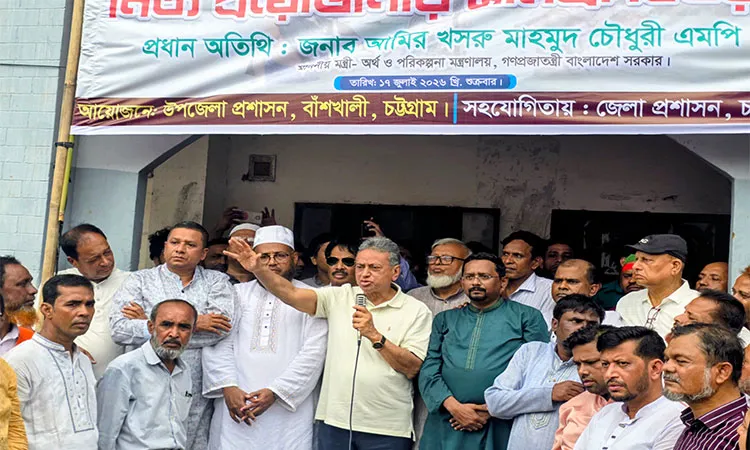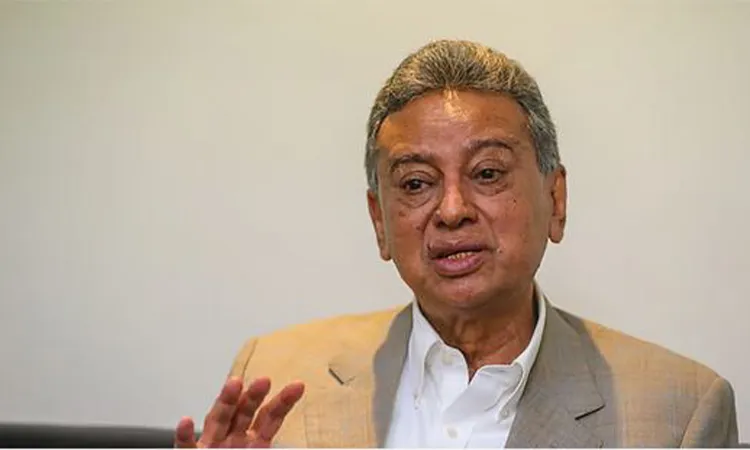
Finance Minister Amir Khasru Mahmud Chowdhury stated on Wednesday that a decision regarding the implementation of the new pay scale will be made only after a thorough review of official recommendations and the country’s current financial health.
Speaking to journalists at the Secretariat on February 17, the Minister emphasized the need for fiscal caution. "We must examine the recommendations and determine what is feasible within our current budget," he said. He highlighted that Bangladesh’s tax-to-GDP ratio remains among the lowest in South Asia, a factor that will heavily influence the decision on the ninth pay scale.
The Finance Minister outlined a vision for a "democratic economy" that moves away from patronage and toward broad-based participation.
"The economy must benefit everyone. Since the events of August 5, there has been a profound shift in the public mindset. Our economic policies must reflect that change," the Minister noted. He identified the recovery of state institutions—focusing on transparency, professionalism, and efficiency—as a top priority.
Beyond traditional manufacturing, the Minister called for the liberalization of the economy to include diverse sectors, including sports, culture, and traditional crafts.
As an example, he pointed to the potential of Shitalpati (traditional mats) weavers. "A standard Shitalpati sells for 600–700 BDT. With proper training, credit access, and online marketing, these craftsmen can reach a global market, transforming local trades into high-value exports," he explained.