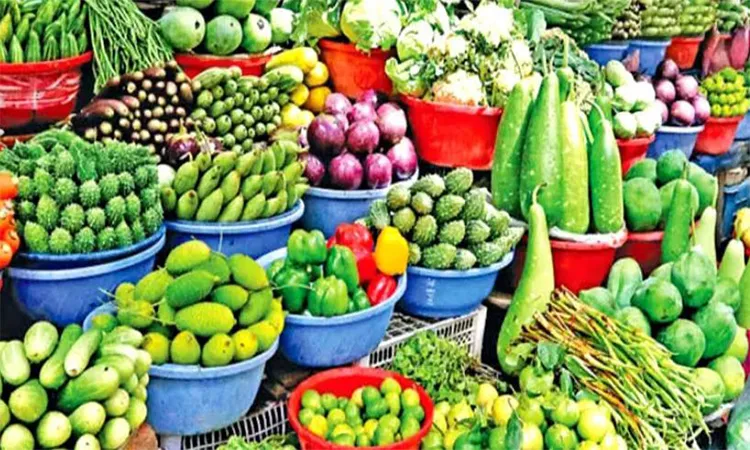
As soon as the holy month of Ramadan began, Chattogram's raw markets have seen an unusual increase in prices. In just a week, the prices of vegetables and daily necessities have increased several times. As soon as Ramadan arrives, the expenses of the common people increase slightly, and the middle-class and low-income people are in the grip of market syndicates, which has made them breathless.
A visit to some raw markets in Chattogram city has shown that the price of lemons, an essential ingredient for iftar, has skyrocketed. Lemons that were sold for 60 to 70 taka a dozen a few days ago are now being sold for 240 taka. That is, the price of a handful of lemons has risen to 80 taka. Similarly, cucumbers that cost 20 to 30 taka are now 80 to 100 taka, and beans that were sold for 40 taka a kg last week are now 140 taka.
The instability in the vegetable market does not end here. Cauliflower, which was available for 20 to 25 taka a few days ago, is now 80 taka per kg. In addition, betel nut is being sold at 120 taka, papaya at 60 taka, brinjal at 70 taka, carrot at 60 taka and bitter gourd at 90 to 100 taka per kg. The price of green chillies has increased to 180 to 200 taka and the price of just 250 grams of coriander leaves has increased from 20 taka to 40 taka. The situation in the chicken market has also not improved. A kg of broiler chicken is being sold at 200 to 220 taka and a kg of golden chicken at 320 to 350 taka. At the same time, the price of fish has also increased in line. Like every year, buyers complain that sellers have increased the prices of essential products during Ramadan even though there is no crisis. On the other hand, the sellers themselves are unable to show any logical reason for the increased prices of many products. They admit that everything is available in sufficient quantity in the market, yet the prices are a little high.
In this regard, Deputy Director of the Department of Consumer Rights Protection, Faiz Ullah, said that a group of business syndicates are systematically increasing prices around the month of Ramadan. They are controlling the entire market by phone and fixing the prices of products. He also said that regular operations are underway to keep the market stable and legal action is being taken against the accused.
Meanwhile, newly elected Prime Minister Tarique Rahman has given a stern warning to keep the prices of daily necessities tolerable during Ramadan. However, the common people demand that the new government not only give assurances, but also take visible and regular monitoring and proper steps by the Department of Consumer Affairs to control the market, and it will be possible to keep the market syndicate under control to some extent.