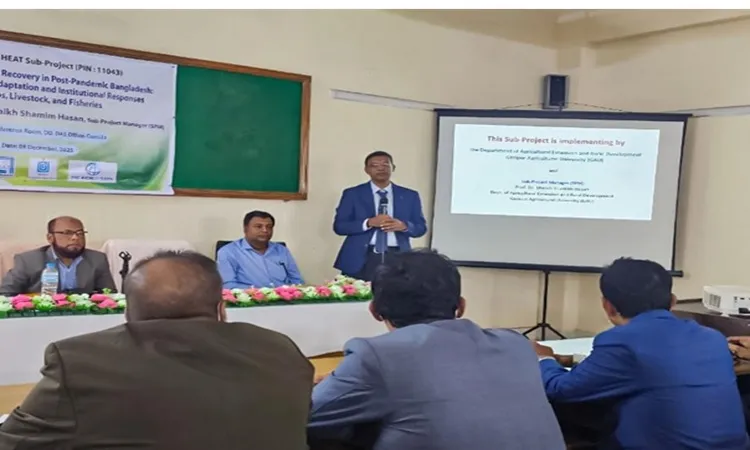
A timely and significant seminar titled “Resilient Agricultural Recovery in Post-Pandemic Bangladesh: Exploring Social Adaptation and Institutional Responses in Crop, Livestock and Fisheries” was held under the overall supervision of Dr. Shaikh Shamim Hasan, Professor of the Department of Agricultural Extension & Rural Development and Sub-Manager of the HEAT Project at Gazipur Agricultural University (GAU).
Funded by the Higher Education Acceleration and Transformation (HEAT) Project, the seminar took place today, 8 December, at 10:30 AM in the conference room of the Deputy Director, Department of Agricultural Extension (DAE), Cumilla Zone. The event aimed to assess the multidimensional impacts of the COVID-19 pandemic on Bangladesh’s economy, society and agriculture-based sectors and to outline a practical framework for long-term recovery. Chief Guest of the seminar was Md. Azizur Rahman, Additional Director, DAE (Cumilla Zone). Md. Mizanur Rahman, Deputy Director, DAE Cumilla, attended as Special Guest.
Agricultural, livestock and fisheries officers from various upazilas participated alongside officials from the DAE. The program began with a welcome address by Professor Dr. Mohammed Zia Uddin Kamal, Assistant Sub-Manager of the project. This was followed by the keynote presentation by Dr. Shaikh Shamim Hasan, who elaborated on research findings, field insights, project objectives, methodologies and expected outcomes. Dr. Hasan noted, “Although our agriculture sector has shown resilience after the pandemic.
we now need a sustainable, science-based recovery roadmap one that can strengthen our preparedness for any future crisis. This seminar is an important step in that direction.” An engaging open discussion followed, where participants shared valuable insights and recommendations. In his remarks, the Chief Guest Dr. Azizur Rahman said, “The pandemic has shown us that agriculture is not just another sector, it is the backbone of our food security and national economy. Evidence-based research is essential for realistic policy formulation. This initiative by Gazipur Agricultural University deserves commendation.”
Comment