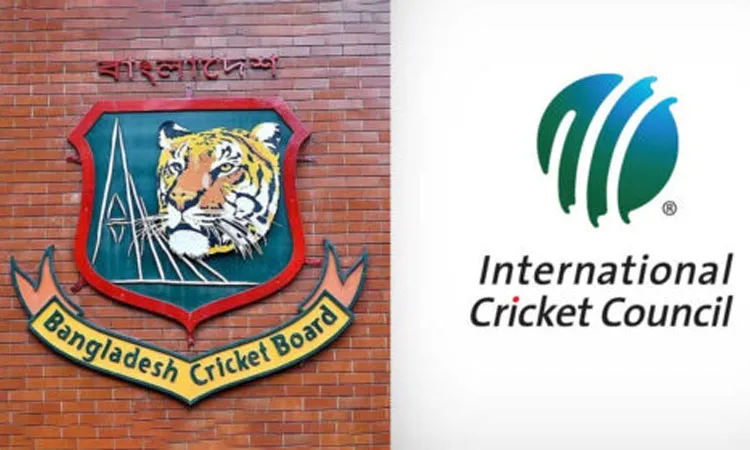
An International Cricket Council (ICC) delegation is visiting Bangladesh today amid ongoing tensions over venues for the upcoming ICC Men’s T20 World Cup. The visit, however, is not expected to reopen talks on hosting arrangements, according to Cricbuzz.
Bangladesh Cricket Board (BCB) President Aminul Islam Bulbul said Andrew F. Grade, head of the ICC’s Anti-Corruption and Security Department, is arriving in Dhaka. A second ICC official, an Indian national, is not part of the delegation after Bangladesh did not issue a visa.
Sports Adviser Asif Nazrul earlier confirmed the visit to local media. Sources say the trip is largely aimed at easing tensions rather than renegotiating World Cup venues.
The dispute followed the removal of Bangladesh pacer Mustafizur Rahman from the Indian Premier League (IPL), which sparked backlash in Bangladesh’s cricket community. The BCB then raised concerns over player safety and formally asked the ICC to move Bangladesh’s World Cup matches from India to Sri Lanka.
The T20 World Cup is scheduled from February 7 to March 8 and will be jointly hosted by India and Sri Lanka. Bangladesh’s four group-stage matches are currently slated for India, while Sri Lanka is already set to host Pakistan’s matches instead of India.
Talks between the BCB and the ICC have so far failed to produce a breakthrough. Bangladesh has maintained it will not play matches in India, citing security concerns, and has requested to play in Sri Lanka even if group allocations must change.
Sources say that if the Bangladesh government maintains its position, Ireland could be moved from Group C to Group B, a change that would require ICC approval. Against this backdrop, the ICC delegation is expected to press Bangladesh to stick to the original schedule.
After Mustafizur’s IPL exclusion, the Bangladesh government halted IPL broadcasts in the country. The BCB has reiterated that traveling to India under current conditions is unacceptable. India has reportedly offered enhanced security measures, including high-level protection, but Bangladesh remains unconvinced.