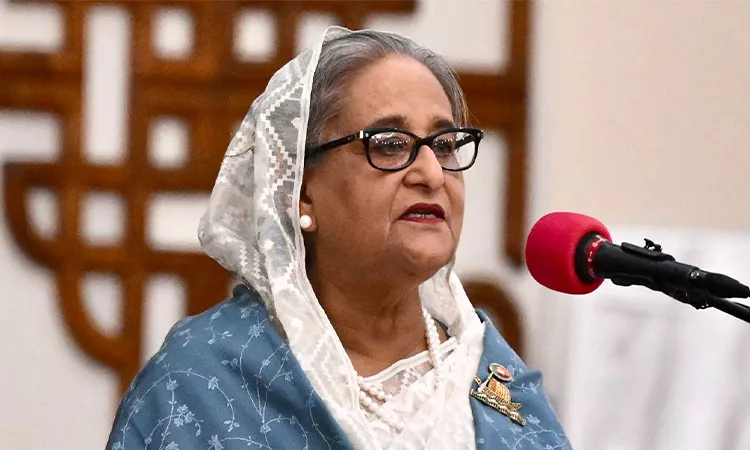
Former prime minister Sheikh Hasina has said that the suspension of the Awami League from political activities has stripped the February 12 general election of democratic legitimacy.
In a wide-ranging written interview with Indian news outlet ThePrint, Hasina accused Chief Adviser Muhammad Yunus and the interim government of dismantling constitutional governance and replacing it with what she described as “authoritarian rule under the guise of reform.”
“You cannot suspend the country’s oldest and most popular political party and then claim democratic legitimacy,” Hasina told ThePrint. “That is not reform. It is authoritarianism presented as transition.”
Although the interim government maintains that the Awami League has not been banned but only suspended from political activity, Hasina dismissed the distinction.
“A party that cannot campaign, organise or contest elections is effectively barred from political life,” she said.
Bangladesh is scheduled to hold national elections on February 12. Hasina argued that excluding the Awami League has already undermined the process and disenfranchised millions of voters.
“Elections held under such conditions cannot be free, fair or credible,” she said, adding that voters are being pressured to support rival parties through intimidation and violence.
Hasina accused the interim government of clearing the political field out of fear of electoral defeat.
“They know that if the Awami League were allowed to contest, it would command overwhelming public support,” she said. “That is why we have been excluded.”
She also criticised Yunus’s leadership, saying he lacks an electoral mandate and has reshaped the legal framework to legitimise what she called unlawful actions.
The Awami League governed Bangladesh from 2009 until Hasina’s removal in August 2024. The upcoming election will be the first since independence without the participation of the party that led the 1971 Liberation War.
2024 Protests and Hasina’s Removal Hasina addressed the mass protests that erupted in mid-2024 over public sector job quotas, which later turned into a broader movement against her government. According to interim authorities, around 1,400 people were killed during the unrest.
She said she regretted every loss of life but denied that her government provoked the violence.
“We allowed peaceful student protests and accepted their demands by scrapping the quota system,” she said. “What followed was the takeover of those protests by extremist elements.”
Hasina accused Yunus of orchestrating violent actions that targeted police stations and state infrastructure, a claim rejected by the interim administration.
As violence intensified in Dhaka, Hasina left her official residence on August 5, 2024, ending her 15-year rule. She has remained in India since then.
Judicial Inquiry and Legal Actions Hasina criticised the interim government for dissolving a judicial inquiry into protest-related deaths that had been formed under her administration.
“That inquiry was scrapped immediately because it would have exposed the planning behind the unrest,” she told ThePrint, calling for an impartial investigation, including possible foreign involvement.
Since her removal, the International Crimes Tribunal has sentenced Hasina and former home minister Asaduzzaman Khan Kamal to death for crimes against humanity related to the suppression of the 2024 protests.
The interim government has also banned the Awami League’s student wing, Bangladesh Chhatra League, under anti-terrorism laws.
Law and Order Concerns Hasina said law and order has deteriorated under an unelected administration.
“Law cannot be enforced through fear or selective action,” she said, calling for elections with the participation of all political parties.
She cited December unrest following the killing of parliamentary aspirant Sharif Osman bin Hadi, which triggered riots and arson attacks on the offices of Prothom Alo and The Daily Star. “The rise in violence reflects a government without public mandate,” Hasina said, accusing the administration of empowering extremist groups and silencing dissent.
Minorities and Jamaat’s Return Hasina also raised concerns about minority safety, referring to incidents of violence against Hindus, including the lynching of Dipu Chandra Das in Mymensingh.
She accused the interim government of rehabilitating Jamaat-e-Islami and allowing extremist ideology to re-enter mainstream politics.
“Bangladesh was founded on secularism and pluralism,” she said. “The return of extremist forces threatens the country’s social fabric.”
Jamaat-e-Islami has re-entered active politics since the ban on the party was lifted, while its student wing, Islami Chhatra Shibir, has gained influence on several university campuses.
History and Identity Hasina also accused the interim government of tolerating efforts to rewrite the country’s history, citing the vandalism of Bangabandhu Sheikh Mujibur Rahman’s residence at Dhanmondi 32.
“Erasing historical truth weakens national identity,” she said. “Preserving the legacy of the Liberation War is about safeguarding sovereignty, not politics.”
As Bangladesh moves toward the February election, Hasina warned that the vote will determine not only who governs the country, but the future direction of the state itself.