
- National
- Bangladesh
- Business
- International
- Sports
- Entertainment
- Politics
- Technology
- Life Style
- Religion
- Opinion
Saturday, 16 May 2026

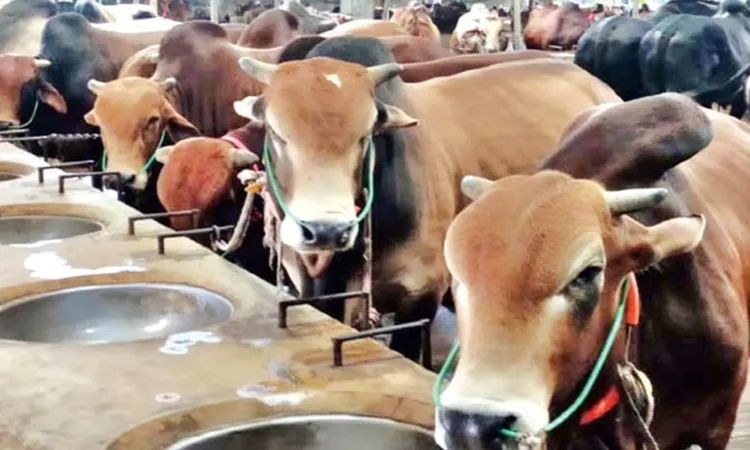
Last-Time preparations are underway at cattle farms across Narail ahead of Eid al-Adha. Farmers in the district have raised around 46,000 sacrificial animals this year, creating a surplus of nearly 6,000 over local demand.
Despite the plenty, local farmers are worried about securing fair prices due to soaring feed costs. A variety of improved and local breeds—including Desi, Shahiwal, and Friesian crosses—have been prepared for the seasonal market.
To avoid the chaotic crowds and middleman fees of traditional cattle markets (haats), buyers are flocking directly to the farms.
"Buying from a haat often means dealing with brokers and higher prices as Eid approaches," said Mizanur Rahman, a local buyer. "Purchasing directly from the farm ensures a healthy animal with less hassle."
However, high production costs remain a major headache for farmers, who also fear that any illegal influx of cattle across the border could crash the market.
Sohag Mina, a local farmer, highlighted the financial strain: "The prices of everything—oilcake, husk, straw, and grass—have skyrocketed compared to last year. Wheat husk is now Tk 55–60 per kg, rice husk is Tk 35–40, and a পণ (pon) of straw costs Tk 3,000–4,500. If we don’t get a fair price, we will face heavy losses."
According to the District Livestock Office, a total of 45,497 animals have been prepared for sacrifice in Narail this year. This includes 14,874 bulls, 639 oxen, 5,141 cows, 24,788 goats, and 55 sheep. Against this supply, the district's internal demand stands at 39,733 animals. The surplus 5,764 animals will be supplied to other districts.
Narail District Livestock Officer Md. Rashedul Haque assured that measures are in place to support the market safely.
"We have trained farmers to ensure safe, natural rearing methods without artificial fattening drugs," Haque said. "This year, 10 official cattle markets will be set up across three upazilas in the district. Mobile veterinary teams will be stationed at these markets to screen for sick or diseased animals."
