


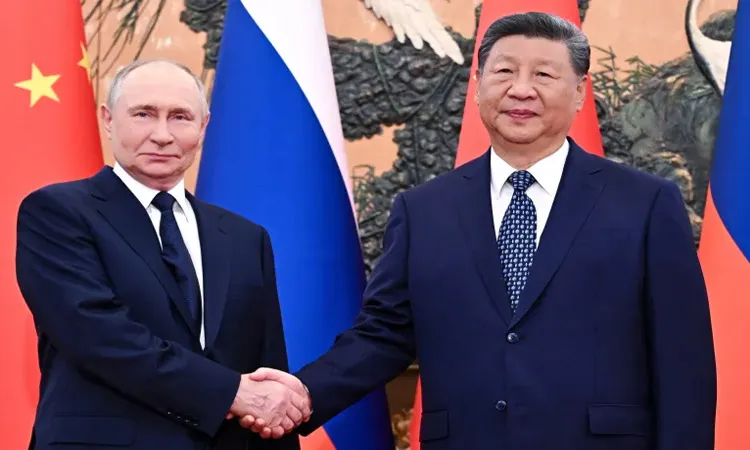
Russian President Vladimir Putin will pay a two-day state visit to China from May 19 to 20 to deepen Moscow and Beijing's "comprehensive partnership and strategic cooperation," officials from both nations confirmed on Saturday.
The visit, at the invitation of Chinese President Xi Jinping, coincides with the 25th anniversary of the landmark 2001 Treaty of Good-Neighborliness and Friendly Cooperation. Aside from summit talks with President Xi, Putin is scheduled to discuss expanding economic and trade ties with Chinese Premier Li Qiang.
The announcement comes just a day after US President Donald Trump concluded a high-profile visit to Beijing the first by a US president in nearly a decade. While Trump and Xi announced several broad trade agreements, their meetings yielded little public progress on deep-seated disputes, including Taiwan and the escalating US-Israel war involving Iran.
Deepening Sino-Russian Alignment
The leaders are also expected to discuss the Russia-Ukraine war. While Beijing maintains official neutrality and President Xi has positioned himself as a potential mediator, China’s "no-limits" alliance with Russia declared just before the 2022 invasion of Ukraine has drawn heavy skepticism from the West.
Furthermore, Beijing has repeatedly denied investigative reports from Reuters and other international media alleging that Chinese firms are sustaining Russian military drone production by shipping engines mislabeled as "industrial refrigeration units."
Despite the lack of a formal military alliance, political and economic ties between Moscow and Beijing have surged as Western sanctions intensified. China has become Russia's largest trading partner by volume, stepping in to purchase Russian oil and goods blocked by Western markets. Trade between the two nations is now conducted almost entirely in Russian rubles and Chinese yuan.
The upcoming summit follows a pattern of high-level engagements. President Xi visited Russia in May last year to pledge joint resistance against "unilateralism and hegemonic bullying" followed by a meeting last month with Russian Foreign Minister Sergey Lavrov, where Xi pushed for even tighter strategic coordination.

