- National
- Bangladesh
- Business
- International
- Sports
- Entertainment
- Politics
- Technology
- Life Style
- Religion
- Opinion
Sunday, 26 April 2026

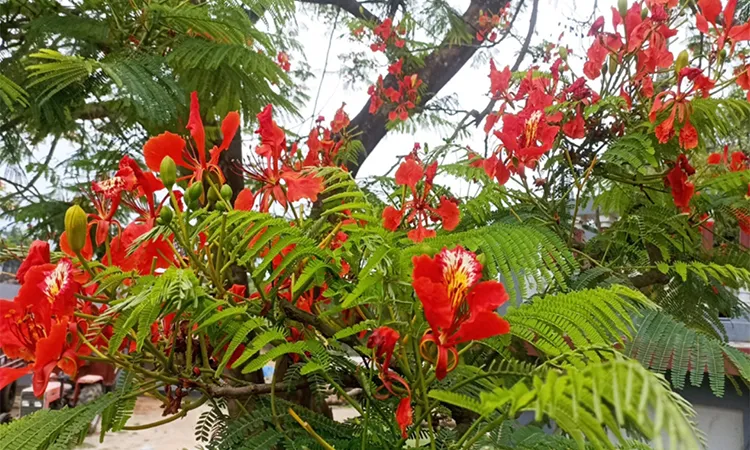
As summer heat settles over the Chitra River banks, the landscape of Narail has been transformed by the vibrant, fiery blooms of the Krishna Chuda (Delonix regia). The bright red flowers, often called "Gulmohar" or "Agunchuda," have breathed new life into the parched seasonal landscape, drawing nature lovers and photographers alike.
Across Lohagara and surrounding upazilas, these perennial trees—members of the Fabaceae family—are in full bloom. From a distance, the dense clusters of five-petaled flowers resemble flickering flames against a backdrop of green foliage.
The beauty of the bloom is most visible near educational institutions and along rural roads. "Standing under these trees provides a sense of peace amidst the summer bustle," says Rezaul Islam, a local content creator. Residents are frequently seen capturing photos, while young women often use the fallen petals to adorn their hair.
Beyond its aesthetic appeal, the Krishna Chuda plays a vital role in the local ecosystem. SM Hatuzzaman, Headmaster of Lohagarh Government Pilot High School, noted that the wide canopy provides essential shade for pedestrians during the scorching heat.
Furthermore, Assistant Professor Kamrunnahar Lina of Lohagara Government Adarsh College highlighted the tree's utility in traditional Unani medicine. "Extracts from the leaves and flowers are known for their anti-inflammatory properties and are used to treat minor skin ailments," she explained.
Despite their importance, environmental activists like Sohel Rana Laxmi warn that the number of these native trees is dwindling due to unplanned urbanization. Local journalists and activists are now calling for a concerted effort to plant new saplings to ensure future generations can enjoy both the cooling shade and the iconic red horizon of a Narail summer.
Comment