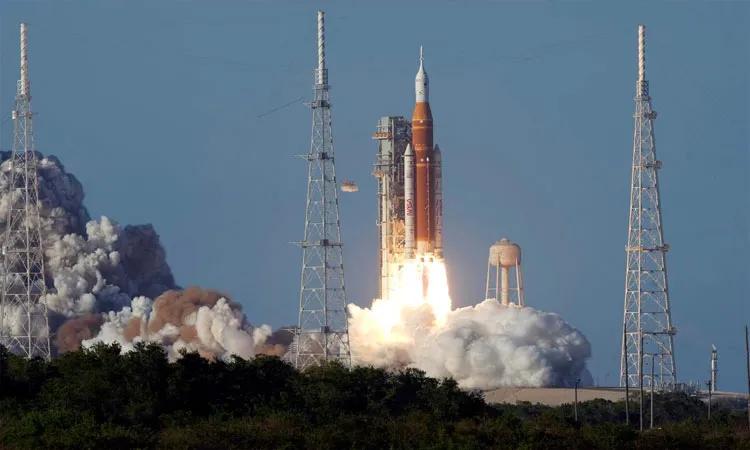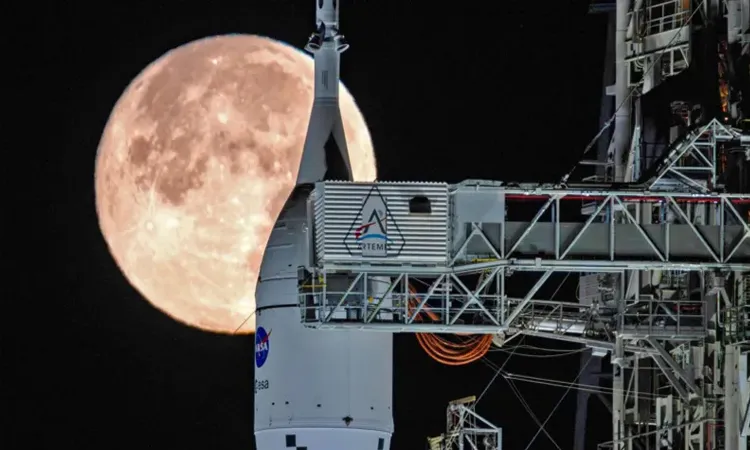
NASA is targeting early March to launch its Artemis II mission, sending astronauts on a 10-day journey around the Moon—the first crewed mission beyond Earth orbit in more than 50 years. The mission will pave the way for a future lunar landing.
Following a successful “wet dress rehearsal” at the Kennedy Space Center in Florida, NASA set the earliest launch date as March 6 (March 7 in the UK). This practice run involved filling the rocket with fuel and completing the full countdown sequence. A previous rehearsal was cut short due to a hydrogen fuel leak, which has now been resolved.

NASA Administrator Lori Glaze said, “The excitement for Artemis II is really starting to build. We can feel it—it’s coming.”
The crew includes three Americans—Reid Wiseman, Victor Glover, Christina Koch—and one Canadian, Jeremy Hansen. Following the rehearsal, the astronauts entered quarantine before launch.
They will travel aboard NASA’s 98-meter (322 ft) Space Launch System (SLS) rocket, with the crew seated in the Orion capsule, about the size of a minibus, where they will live, eat, work, and sleep during the mission.
The first day will be spent orbiting Earth, then the crew will travel four days to the Moon, passing over the far side of the Moon, 6,500–9,500 km (4,000–6,000 miles) above the surface. They will spend several hours observing and photographing the Moon before returning to Earth for a four-day journey back, ending with a Pacific Ocean splashdown.
If successful, Artemis II will set the stage for Artemis III, which aims to land astronauts on the Moon by 2028. NASA is coordinating with SpaceX and Blue Origin to accelerate lunar landing plans, amid competition with China, which is targeting a Moon landing by 2030. Both nations plan to explore the Moon’s south pole for future bases.