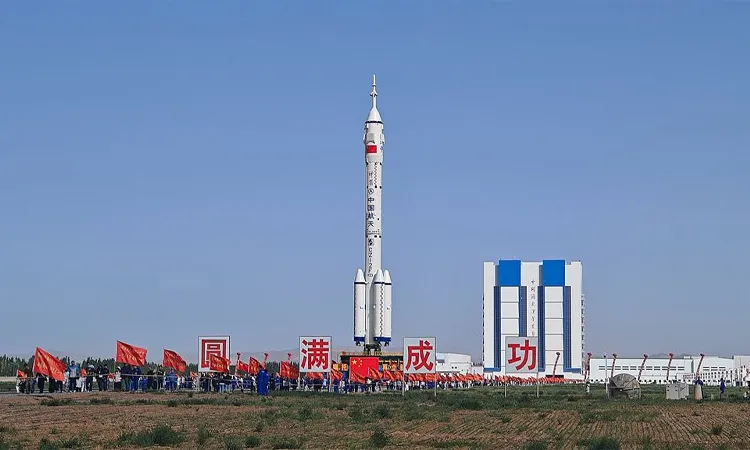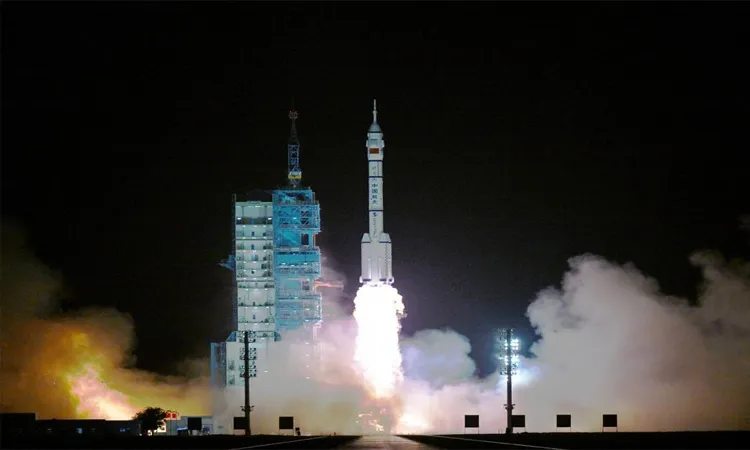
China successfully launched the Shenzhou-23 crewed spacecraft late Sunday, marking a major milestone in its space program with a mission designed to set a new domestic in-orbit endurance record. The mission is a crucial stepping stone toward Beijing’s goal of a crewed lunar landing by 2030.
The spacecraft, carried by a Long March-2F rocket, blasted off at 11:08 PM Beijing Time from the Jiuquan Satellite Launch Center in northwest China. The China Manned Space Agency (CMSA) declared the launch a complete success after the vessel separated smoothly from the rocket and entered its designated orbit roughly 10 minutes later.

The crew includes mission commander Zhu Yangzhu, an experienced astronaut from the Shenzhou-16 mission, alongside rookie pilot Zhang Zhiyuan and payload specialist Li Jiaying. Li, a former Hong Kong police inspector, makes history as the first astronaut selected from the Hong Kong Special Administrative Region and China's fourth female astronaut in space.
Upon executing a fast, automated rendezvous and docking with the Tiangong space station complex, the trio will conduct an in-orbit handover with the Shenzhou-21 crew, who have already spent a record 204 days in orbit.

While previous Chinese missions have lasted six months, at least one astronaut from the Shenzhou-23 crew is slated to remain aboard Tiangong for a full year. This extended stay will allow scientists to execute China's first space-based human-body research program, mapping a multi-system atlas to study advanced radiation exposure, bone density loss, and long-term psychological stress.
Additionally, the crew will oversee more than 100 cutting-edge scientific experiments. These include cultivating two consecutive generations of rice seeds in microgravity, testing perovskite solar cells under extreme space environments, and pioneering space embryonic research utilizing zebrafish, mouse embryos, and stem-cell-derived "artificial embryos."
The technical data gathered during this residency will directly feed into China's heavy hardware preparations—including the Mengzhou spacecraft and Lanyue lunar lander—ahead of its upcoming lunar and permanent space base ambitions.