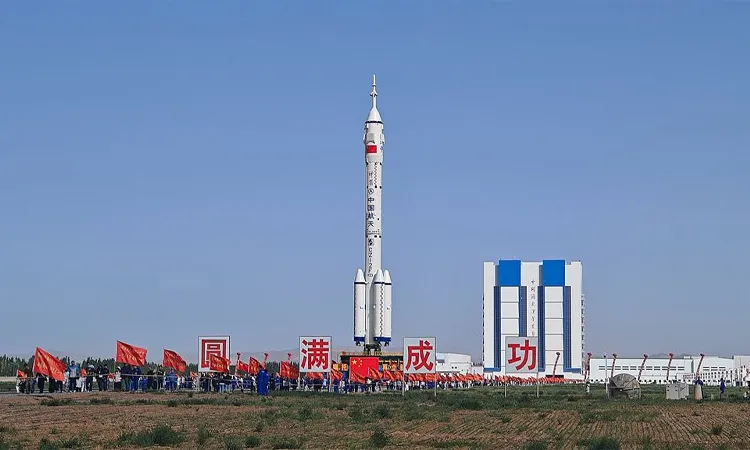
China is set to launch its Shenzhou-23 crewed spacecraft tonight at 11:08 PM from the Jiuquan Satellite Launch Center in northwest China, the China Manned Space Agency announced.
The launch marks China's 40th crewed space flight and the seventh mission during the development phase of its permanent space station.
Following a fast automated rendezvous and docking process, the Shenzhou-23 capsule will connect with the radial port of the Tianhe core module. The incoming crew will conduct a standard in-orbit rotation with the existing Shenzhou-21 crew, who have spent 203 days in space. This handover will establish a new record for the longest continuous stay by a Chinese crew in orbit before the Shenzhou-21 team returns to Earth at the Dongfeng landing site.

The new crew will execute over 100 scientific projects spanning space life sciences, material research, and aerospace medicine. Notably, one crew member is slated for a historic, year-long in-orbit residency. This 12-month stay serves as China's premier human research program in space, gathering vital medical and psychological data on long-duration spaceflight to support future upgrades and deep-space travel.
The mission's experimental framework targets distinct breakthroughs across multiple scientific frontiers: Space Embryology: Researchers will study the growth of zebrafish embryos, mouse embryos, and stem-cell-derived "artificial embryos" to analyze life development under microgravity.
Advanced Materials: Testing will focus on the space-based manufacturing of high-performance rare-earth permanent magnetic alloys and lightweight high-entropy alloys.
Energy Storage: In-orbit validation of new aerospace batteries will be conducted to optimize power systems for future space station expansions.
The space agency also confirmed that two Pakistani astronauts are currently training alongside Chinese taikonauts. Under a bilateral space cooperation agreement, one of the Pakistani candidates will eventually serve as a short-term payload specialist.
Their current regimen includes intensive technical flight training, practical equipment operation, and specialized Chinese command language lessons to ensure full operational readiness.