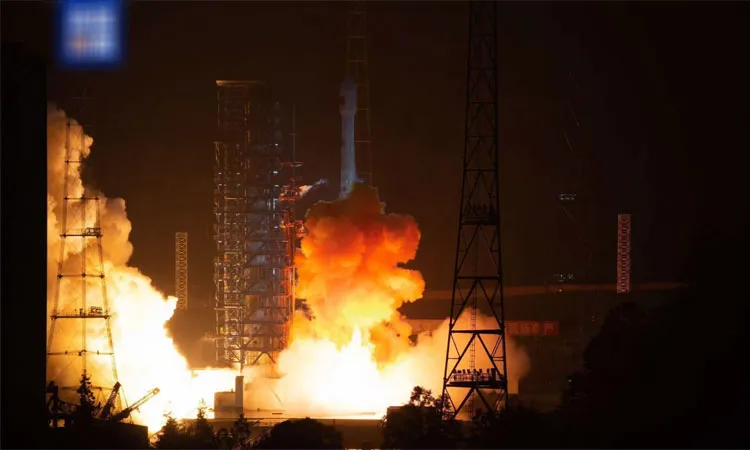
The Solar wind Magnetosphere Ionosphere Link Explorer (SMILE), a joint mission by the Chinese Academy of Sciences (CAS) and the European Space Agency (ESA), was successfully launched Tuesday from Europe's Spaceport in French Guiana.
Carried by a Vega-C rocket, the satellite has entered its planned orbit with its solar panels successfully deployed.

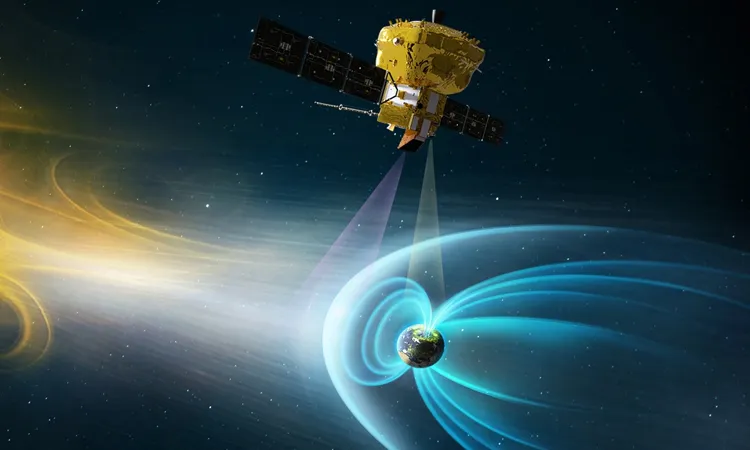
The SMILE mission is the first comprehensive, mission-level space science collaboration between China and Europe. Its primary goal is to use soft X-ray imaging to study Earth's outermost magnetosphere, revealing exactly how solar winds interact with our planet.

Solar winds—high-speed plasma flows from the sun—can cause intense space weather events, such as geomagnetic storms. These storms pose direct threats to orbiting satellites, navigation systems, communication networks, and high-latitude power grids. Earth’s magnetosphere acts as a natural shield, and understanding this interaction is vital for protecting modern technology.
Equipped with four advanced scientific instruments, SMILE will capture global soft X-ray and ultraviolet images of auroral activity and magnetic boundaries. It will also conduct real-time measurements of magnetic field variations and solar wind ions.

After a 42-day orbital maneuver and two months of in-orbit testing, the satellite will begin a three-year regular observation period.
The stable data gathered by SMILE is expected to fundamentally improve space weather forecasting, ensuring better protection for near-Earth space assets and global communication systems.