


Around 40,000 residents in Orange County, California, face mandatory evacuation orders as emergency crews battle to prevent a toxic chemical tank from leaking or exploding.
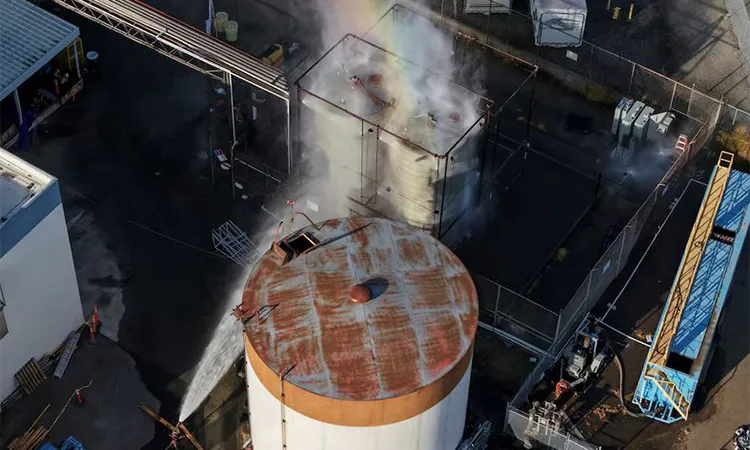
For two days, responders have worked around the clock to cool a damaged storage tank filled with roughly 7,000 gallons of methyl methacrylate (MMA) at the GKN Aerospace facility in Garden Grove. The escalating crisis prompted authorities to clear a 9-square-mile radius, displacing tens of thousands of people.

MMA is a highly volatile and flammable chemical used to manufacture plastics. The U.S. Environmental Protection Agency warns that inhaling its vapors can cause severe respiratory irritation, dizziness, and nausea.
By Friday evening, the tank's temperature had finally started to drop. Orange County Fire Authority Division Chief Craig Covey reported it had cooled to about 61 degrees Fahrenheit—closer to its safe baseline of 50 degrees. The cooler temperatures have allowed hazmat crews to safely approach the tank and attempt new containment strategies.
Despite this progress, officials remain on high alert due to a damaged valve that prevents them from safely pumping the chemical out of the container.
"This thing is going to fail," Covey warned bluntly during a press briefing, stressing the urgent need for residents to leave the area. "There are literally two options left... the tank fails and spills, or the tank goes into a thermal runaway and blows up."
Police used reverse 911 calls and social media alerts to urge residents to flee. However, Garden Grove Police Chief Amir El-Farra noted that about 15% of the affected population—roughly 6,000 people—initially refused to evacuate. The emergency also forced the closure and evacuation of 13 local schools.

The industrial site sits just 5 miles from Disneyland and 4 miles from Knott’s Berry Farm, though neither park is currently under evacuation orders.
Orange County Health Officer Dr. Regina Chinsio-Kwong assured the public that air quality remains safe outside the designated evacuation zone, as MMA vapors are heavier than air and sink to the ground. While the chemical has a distinct, fruity odor, smelling it does not necessarily mean exposure has reached harmful levels.
Because large-scale human exposure to MMA is rare, health officials say the exact impacts of a potential explosion remain unpredictable—making evacuation the only safe choice. "We’re going into unique times, and we have limited information," Chinsio-Kwong said.
The incident began Thursday afternoon when the tank overheated, releasing vapors and triggering overhead safety sprinklers. Initial evacuation orders were lifted Thursday night but were quickly reinstated and expanded Friday morning as the tank's structural integrity worsened.
The disruption has taken a heavy toll on the community. “I was sleeping in my house until this morning when they told us we had to leave,” resident Diane Chavira told local reporters as she frantically gathered her four dogs.

“It’s been chaos,” added Jacqueline Riegos, an evacuee from nearby Stanton. “Nobody can really give us any details about what’s going on. And we don’t know how long this is going to be.”
Given the unpredictable nature of the chemical and changing wind patterns, officials are urging all residents in the affected zones to prioritize their safety. GKN Aerospace, the facility's owner, stated they are working closely with emergency services to resolve the crisis.

