


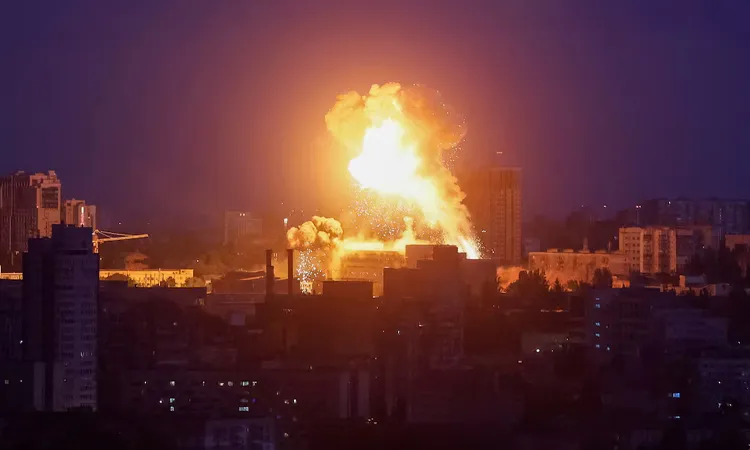
Russia launched one of its heaviest bombardments of the four-year war on Sunday, striking Kyiv and surrounding areas with a massive barrage of 90 missiles and 600 drones. The assault included the rare deployment of an Oreshnik hypersonic intermediate-range missile near the capital.
The hours-long overnight attack killed at least four people and wounded nearly 100 others across the region, according to Ukrainian authorities. Extensive damage was reported in central Kyiv, hitting dozens of residential high-rises, several schools, the Foreign Ministry, and the national art museum. One strike completely destroyed a newly opened museum dedicated to the 1986 Chornobyl nuclear disaster.

President Volodymyr Zelenskiy strongly condemned the onslaught, calling for immediate, decisive counteractions from international allies, including the United States and Europe. European Union and British officials slammed the deployment of the nuclear-capable Oreshnik missile, characterizing the move as reckless nuclear brinkmanship and a major escalation.
While Moscow claimed the strikes targeted Ukrainian military command centers, intelligence facilities and arms factories in retaliation for Ukrainian cross-border actions, the reality on the ground showed widespread devastation in civilian areas. In Kyiv's Lukyanivka district, a local marketplace and shopping mall were completely gutted by flames, forcing hundreds of residents to seek shelter overnight inside underground metro stations.

This marks only the third time Russia has fired the Oreshnik hypersonic missile since the February 2022 invasion. President Zelenskiy confirmed that this specific missile targeted Bila Tserkva, a city of 200,000 residents located roughly 64 kilometers from Kyiv. Weapons investigators reviewing footage noted that the missile's warhead split into 36 distinct submunitions upon impact.
Zelenskiy added that Russia also deliberately targeted critical water-supply networks ahead of peak summer demand.

