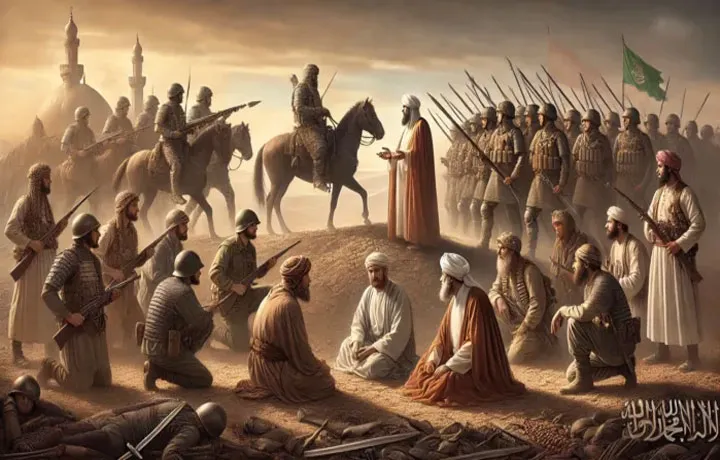
Today marks the 17th day of Ramadan, a significant date in Islamic history. On the 17th of Ramadan in the 2nd Hijri year, a small group of about 313 Muslims faced a much larger and well-equipped army of more than a thousand opponents in what is known as the historic Battle of Badr. Despite limited resources, the Muslim army achieved a decisive victory.
The battle is widely remembered as a turning point that strengthened the position of the early Muslim community and symbolized the triumph of truth over oppression.
Before the battle began, the Prophet Muhammad (peace be upon him) instructed the Muslim army to uphold strict moral conduct in warfare. He ordered them not to harm women, children, elderly people, religious devotees, animals, or fruit-bearing trees. These instructions are often cited as early principles of humanitarian conduct in war.
During the battle, 14 Muslim companions were martyred. On the opposing side, around 70 fighters were killed and another 70 were captured. The prisoners were treated with dignity. Those accused of serious crimes faced legal consequences, while others were held until ransom was paid.
Historical accounts mention that prisoners who could not afford ransom were allowed to earn their freedom by teaching ten children of Medina to read and write. Companions of the Prophet reportedly treated the captives with compassion, sharing food with them and ensuring their basic needs were met.
Islamic historians also highlight the social and political context before the battle. After migrating to Medina, the Prophet Muhammad (peace be upon him) established a written agreement among Muslims, Jews and other communities—commonly known as the Constitution of Medina. This agreement aimed to create a peaceful and cooperative society where different religious groups could live together under shared rules.
However, tensions with the Quraysh of Mecca eventually led to armed confrontation. When news of the approaching enemy reached Medina, the Prophet consulted his companions. Both the Muhajirin (migrants from Mecca) and the Ansar (helpers of Medina) expressed strong support and readiness to defend their community.
The Muslim force then marched to the desert of Badr. Historical narrations describe the Prophet praying earnestly for divine support before the battle. Islamic tradition holds that divine assistance helped the Muslim army during this critical moment. The Qur’an also references the event, stating that God supported the believers at Badr when they were weak (Surah Al-Imran: 123).
Despite being outnumbered and poorly equipped, the Muslim army fought with determination and discipline. The victory at Badr became a defining moment for the early Muslim community and is remembered as a symbol of faith, courage and unity.
Islamic scholars say the Battle of Badr also offers lessons about justice, ethical conduct during conflict, and the humane treatment of prisoners of war. For Muslims around the world, the event remains one of the most important milestones in the early history of Islam.
Author: Mohammed Nurul Absar Taiyobi is a writer, researcher, and Islamic thinker. He is the Founder President of the Expatriate Journalists Association (PRASAS) based in Dubai, UAE. Additionally, he serves as the Chairman of the Islamic Research Center located in Abu Dhabi, UAE. For correspondence, he can be reached at: muntyping@gmail.com