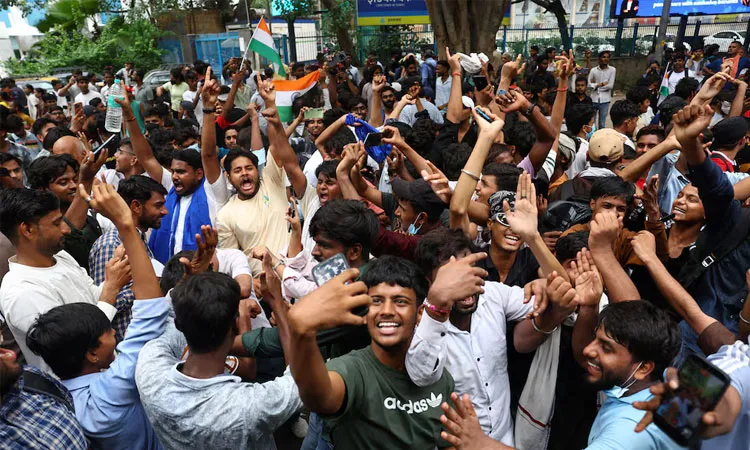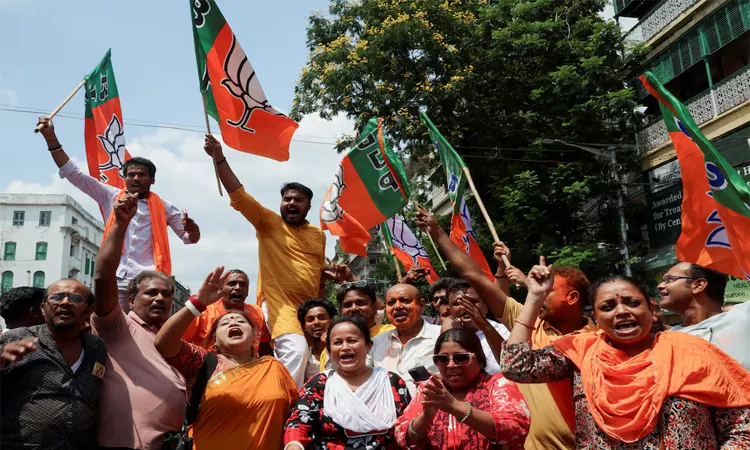
Prime Minister Narendra Modi’s Bharatiya Janata Party (BJP) achieved a historic political breakthrough on Monday, seizing control of West Bengal for the first time and ending Mamata Banerjee’s 15-year administration.
The victory in the east was bolstered by a decisive win in Assam, where the BJP-led alliance secured a third consecutive term win.

The BJP crossed the majority threshold in the 294-member West Bengal Assembly, leading or winning in 208 seats. This surge decimated the incumbent Trinamool Congress (TMC), which saw its tally drop to approximately 79–90 seats, a sharp decline from its 2021 performance.

In a high-stakes personal battle, BJP’s Suvendu Adhikari defeated Chief Minister Mamata Banerjee in the Bhabanipur constituency by over 15,000 votes. Banerjee has alleged electoral irregularities, claiming counting agents were intimidated, though the Election Commission’s data suggests a broad "Saffron" sweep across former TMC strongholds.
Assam and Southern Shifts
Assam: Chief Minister Himanta Biswa Sarma led the NDA to a landslide, winning 102 out of 126 seats. Sarma retained his Jalukbari seat for a sixth term with a record margin of over 85,000 votes.

Tamil Nadu: In a major upset, actor-politician Vijay’s debutant party, Tamilaga Vettri Kazhagam (TVK), emerged as a dominant force, leading in 111 seats and threatening the incumbent DMK’s hold on power.

Kerala: The Congress-led United Democratic Front (UDF) is set to form the government, winning 63 seats and stopping the CPI(M)’s bid for a third term. Notably, the BJP won three seats in Kerala, marking its strongest performance in the state to date.

Impact on National Politics
The results significantly strengthen Modi’s position midway through his third term. Analysts suggest the gains in the east and the weakening of the Congress-led INDIA alliance partners (TMC and DMK) will likely accelerate the BJP’s national agenda, including uniform civil laws and major infrastructure projects.