- National
- Bangladesh
- Business
- International
- Sports
- Entertainment
- Politics
- Technology
- Life Style
- Religion
- Opinion
- FIFA World Cup 2026
Friday, 26 June 2026

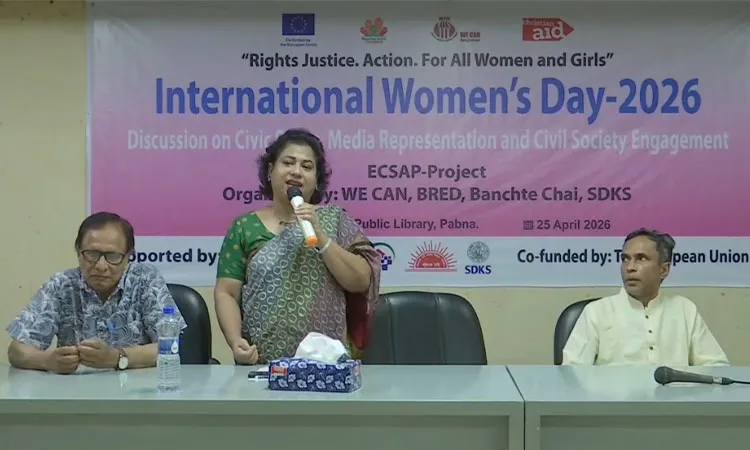
Journalists and rights activists gathered at the Pabna Annada Govinda Public Library on Saturday to discuss the socio-economic challenges faced by indigenous and marginalized communities.
The discussion, titled "Civil Scope, Media Representation, and Civil Society Participation," was held to mark International Women’s Day 2026. It forms part of the ongoing "Rights, Justice, and Activism of Women and Girls" initiative, supported by the European Union and Christian Aid.

The meeting highlighted the daily struggles of Pabna’s tribal, Harijan, and Dalit communities. Participants emphasized that while these groups face significant socio-economic hurdles, their stories are often underrepresented in mainstream media.
Key speakers, including Pabna Press Club President Akhtaruzzaman Akhtar and veteran journalist Abdul Matin Khan, urged media workers to move beyond surface-level reporting. They called for deep-dive field reports that can pressure the government to address the systemic issues plaguing these backward communities.

The event was organized by a coalition of NGOs including We Can, BREAD, Bachte Chai, and SDKS under the ECSAP project. Thirty media professionals from Pabna Sadar, Ishwardi, Atgharia, and other upazilas attended.
WICAN officers Marufia Noor and Nazmus Shakib presented data on the impact of ongoing community support programs.
Journalists from national and local outlets, such as The Daily Star and Masranga Television, discussed how to better integrate the "civil scope" into daily reporting to protect vulnerable women and girls.
The session concluded with a call for stronger synergy between NGOs and the press to ensure that the "last person in the queue" receives justice and state benefits.