- National
- Bangladesh
- Business
- International
- Sports
- Entertainment
- Politics
- Technology
- Life Style
- Religion
- Opinion
Tuesday, 03 March 2026

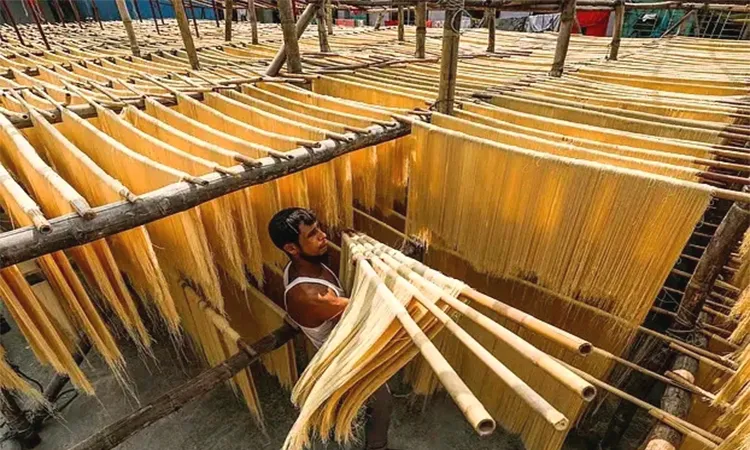
Demand for Semai exists throughout the year in Bangladesh, but the Chaktai-Rajakhali area of Chittagong comes alive as Eid-ul-Fitr approaches. Production and sales during this month surge several times higher than in the rest of the year.
Since the start of Ramadan, small and large factories have been bustling with craftsmen, working day and night to make traditional Bangla, Lachcha, and fried Semai. Areas such as Chaktai, Rajakhali, Baklia, Khatunganj, and Madarbari were once famous for semai-making.
Despite the rise of automated machines, many hand-operated factories continue due to tradition. Dough is prepared and yeast is inserted into hand-operated dice. As the machines rotate, thin semai threads emerge, which are sun-dried and then fried until reddish, ready for market sale.
Traders estimate that about 20,000 tons of semai will be produced in Chittagong this Eid. This supply meets local demand and is also sent to surrounding districts at wholesale prices. However, the industry’s golden era is fading. Many small hand-operated factories have closed due to competition from large automated companies, and some remaining factories are shifting toward automation to increase production.
A businessman from Chaktai Lathir Pul noted that in the past, semai production started two to three months before Ramadan. Today, with technology, production continues year-round, and small factories have spread across the country, reducing Chaktai’s monopoly.
Craftsmen trained in Chaktai have also opened factories in other regions, decentralizing this traditional craft. Meanwhile, some businesses exploit the Eid demand while ignoring hygiene and environmental standards. Recently, a mobile court fined ‘Aman Food Products’ and ‘Rafiq Rafiq Food Products’ Tk 220,000 for producing low-quality semai in unsanitary conditions in Baklia. The penalty, imposed under Sections 39 and 41 of the Safe Food Act, 2013, also cited misleading packaging information. Executive Magistrate Masuma Akhter Kona confirmed that such inspections and mobile court operations will continue to protect public health.
Comment