- National
- Bangladesh
- Business
- International
- Sports
- Entertainment
- Politics
- Technology
- Life Style
- Religion
- Opinion
Sunday, 05 April 2026

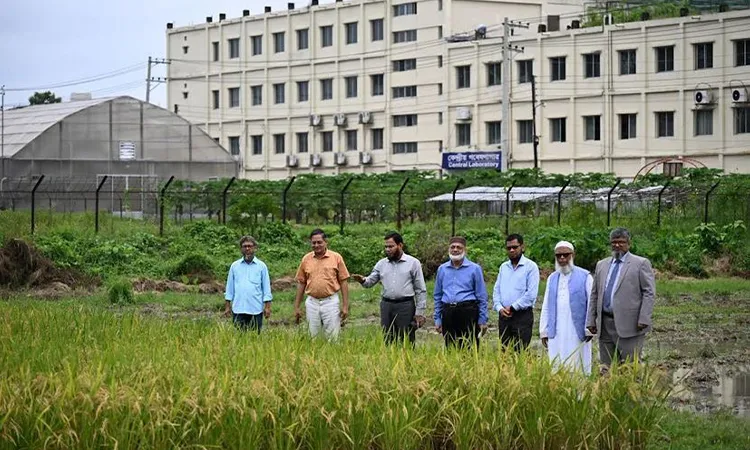
A short-term, high-yielding and fine-grain Aush rice variety named ‘GAU Dhan 4’ has been developed by researchers at Gazipur Agricultural University (GAU).
The variety was developed by Professor Dr. M. Mainul Haque and Professor Dr. Md. Mosiul Islam of the university’s Department of Agronomy after nearly a decade of research.
According to Professor Md. Mosiul Islam, the development of GAU Dhan 4 marks a significant milestone, bringing the total number of crop varieties developed by the university to 95, including four rice varieties.
Aush rice in Bangladesh typically produces lower yields than Aman and Boro varieties. However, GAU Dhan 4 offers higher productivity within a shorter growing period. The crop matures in about 90 to 100 days, allowing farmers to cultivate three to four crops annually on the same land.
The variety is suitable for cultivation across most regions of the country and requires comparatively less water, making it important for climate-resilient farming. It may also benefit farmers in northern regions affected by seasonal constraints.
Researchers developed the variety by crossing the fine-grain, high-yielding ‘BU Dhan 2’ with the traditional Aush variety ‘Parija’. After years of selection, the GAU-9974-52-7-2 line showed consistent performance.
Field trials were conducted over 10 years, followed by regional adaptation tests in 2022, regional suitability trials in 2023, and multi-location field evaluations in 2024 under the Bangladesh Seed Certification Agency.
The National Seed Board approved the variety as ‘GAU Dhan 4’ at its 115th meeting on February 5, 2026.
The rice has long, slender grains and yields about 5 to 5.5 tonnes per hectare under favourable conditions. It requires 25–30 kg of seed per hectare and produces 10–15 percent higher yields than conventional varieties.
Nutritionally, the rice contains about 8.38 percent protein and 24.58 percent amylose, supporting energy supply and digestion.
The variety shows tolerance to common pests and diseases and adapts well to different environmental conditions. Sandy loam and clay loam soils are suitable for its cultivation.
The ideal sowing time is early April, with seedlings transplanted after 20–22 days. Recommended spacing is 20 cm between rows and 15 cm between plants.
Professor Md. Mosiul Islam said the goal was to develop a short-duration, high-yielding and marketable fine rice variety. He expressed hope that it would increase farmers’ income and strengthen national food security.
Vice-Chancellor Professor Dr. GKM Mostafizur Rahman congratulated the researchers, describing the achievement as a reflection of the university’s commitment to agricultural innovation and farmer welfare.
Comment