- National
- Bangladesh
- Business
- International
- Sports
- Entertainment
- Politics
- Technology
- Life Style
- Religion
- Opinion
- FIFA World Cup 2026
Monday, 17 August 2026


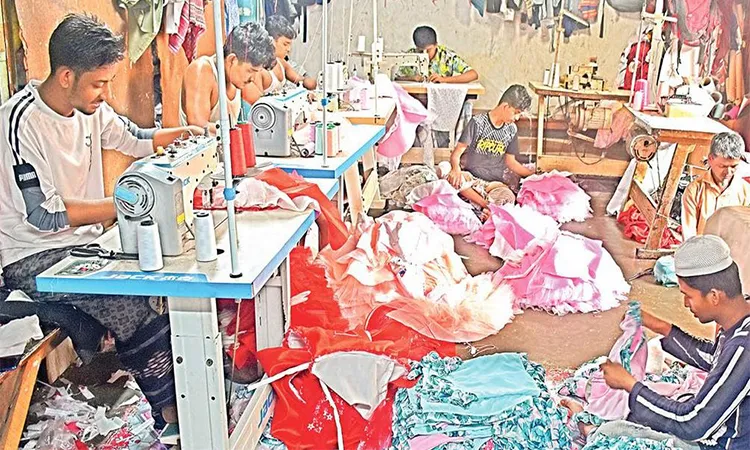
The rhythmic whirring of sewing machines echoes day and night through the narrow lanes of Khalifapatti. As Eid-ul-Fitr approaches, this historic tailoring hub in Chattogram—locally known as Darjipara—has transformed into a hive of sleepless activity.
The legacy of Khalifapatti dates back to 1947, when a tailor named Ayub Ali from Noakhali began his craft at Ghat Farhadbeg with a few apprentices. Over nearly eight decades, that small venture evolved into a massive wholesale cluster. Today, the area near the Andarkilla intersection is home to over 300 factories, each a compact powerhouse of 100 to 200 square feet where generations of artisans work side-by-side.
Traders here source fabrics from Dhaka’s Islampur and Chattogram’s Terry Bazar, converting them into trendy outfits. While Khalifapatti produces garments for all ages, the focus remains heavily on women’s and children’s wear. From traditional sarees and three-piece suits to modern lehengas, ghararas, and skirts, the "design masters" of Khalifapatti blend local aesthetics with foreign inspirations.
“We wait for this season all year,” says Salauddin, a local tailor. “Nearly 80% of our annual business is centered around Eid.”
Prices in the hub are remarkably accessible, ranging from 150 BDT to 5,000 BDT. This affordability allows Khalifapatti to compete with imported garments. According to Md. Imam Hossain, General Secretary of the Khalifapatti Banik Kalyan Samiti, the demand has now spread far beyond Chittagong to various upazilas and neighboring districts.
The working conditions are intense. In cramped rooms lit by energy-saver bulbs, over 4,000 workers—both men and women—battle the sweltering heat to meet advance orders.
Md. Sharifullah, who has worked here for 45 years since the age of 10, notes the resilience of the trade. "Despite economic fluctuations, business is currently brisk. People come here because they know they can get quality designs at a price that fits their budget," he said.
As the countdown to Eid continues, the 24-hour cycle of cutting, sewing, and lace-work shows no sign of slowing down, ensuring that thousands of families across the country can celebrate the festival in new clothes.