- National
- Bangladesh
- Business
- International
- Sports
- Entertainment
- Politics
- Technology
- Life Style
- Religion
- Opinion
Saturday, 18 April 2026

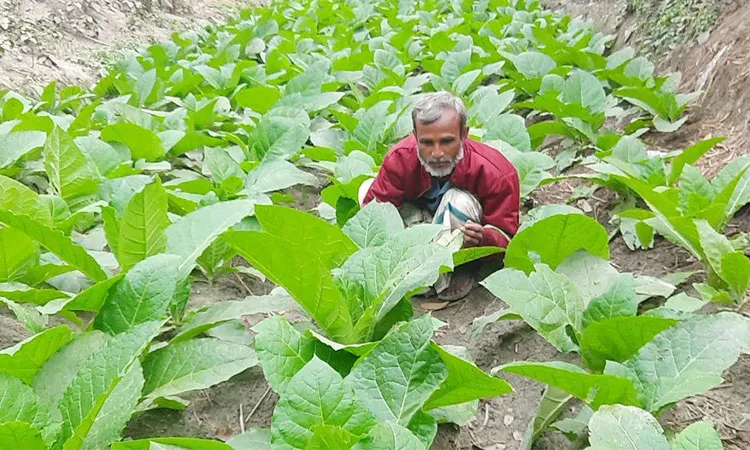
The trend of tobacco cultivation is increasing day by day in the areas along the banks of Teesta river in Kaliganj upazila of Lalmonirhat at an alarming rate.
Farmers are leaning towards this cultivation despite knowing the health risks due to the temptation of tobacco companies and the hope of higher profits. However, behind this profitable crop, there are serious health risks, reduced soil fertility and the threat of environmental disaster.
A few years ago, rice, wheat, corn, mustard, potatoes and various early varieties of vegetables were cultivated in the vast arable land including Teesta in the district. Currently, tobacco fields have taken over a large part of those lands.
Talking to farmers of Bhotmari Union in Kaliganj Upazila, it was learned that among the five upazilas of the district, Hatibandha, Kaliganj and Aditmari are the most tobacco-growing areas. Farmers claim that they do not get a fair price by cultivating other crops. In addition, they face losses every year due to the increase in labor wages. Despite being aware of the health risks for these reasons, they are interested in tobacco cultivation in the hope of more profits.
In addition, another major reason for being attracted to tobacco cultivation is the incentives of cigarette companies. The companies are further encouraging farmers to cultivate tobacco by providing cash, seeds and urea-BSP fertilizer per acre of land.
District Civil Surgeon Nirmalendu Roy said that the risk of respiratory problems, stroke, cancer, skin and sexually transmitted diseases including cancer is significantly increasing due to tobacco cultivation and consumption of tobacco products. The toxic effects of tobacco are not limited to farmers alone; it has a serious impact on the health of their family members and even children.
Deputy Director of the Lalmonirhat Department of Agricultural Extension, Dr. Md. Saikhul Arifin said that this year, a total of 15,057 hectares of land have been cultivated with tobacco in five upazilas of the district, which is significantly more than the previous year.
Experts say that long-term tobacco cultivation is destroying the fertility of the land and negatively affecting the environment. In this situation, it is important to make farmers interested in cultivating alternative profitable crops to discourage tobacco cultivation. The local administration and health department have called for working together to solve the problem.
Comment