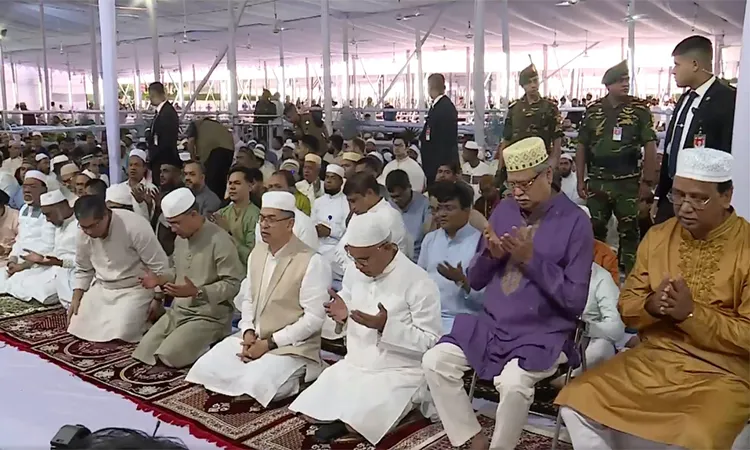
Eid-ul-Azha, the festival of sacrifice, is being celebrated across Bangladesh with due solemnity and religious fervor. Millions of Muslims from all walks of life gathered at mosques and open grounds (eidgahs) across the country on Thursday morning to offer their Eid prayers.
The nation’s primary Eid congregation was held at the National Eidgah Maidan in the capital at 7:30 AM. Presided over by Mufti Mohammad Abdul Malek, the Khatib of the Baitul Mukarram National Mosque, the congregation drew thousands of devotees.

President Mohammed Shahabuddin and Prime Minister Tarique Rahman attended the main service alongside cabinet ministers, Supreme Court justices, senior politicians, diplomats and high-ranking government officials.
Tight Security and Festive Spirit
From the early hours of Thursday, devotees clad in new panjabis and caps formed long, orderly lines stretching from Paltan Crossroad, Matsya Bhaban, the High Court and Dhaka University to enter the grounds.

Despite official advisories noting that prayer mats were provided on-site, many devotees brought their own, alongside umbrellas and water bottles due to rain forecasts. Children and teenagers accompanied their guardians, adding to the palpable festive spirit.
To ensure public safety, law enforcement agencies enforced strict security protocols. Devotees entered the venue shoulder-to-shoulder through designated gates equipped with security archways and underwent thorough checks.

Large-Scale Infrastructure and Arrangements
The Dhaka South City Corporation (DSCC) undertook extensive preparations to accommodate the massive influx of worshippers at the 33,000-square-meter National Eidgah Maidan.
The main covered area (pandal) spans 25,400 square meters, designed to comfortably accommodate 35,000 worshippers across 121 rows. Overflow space was allocated on adjacent roads.
Dedicated sections and separate entrances were set up for women, accommodating roughly 3,500 female worshippers alongside 31,000 men. A specialized VIP enclosure accommodated 250 men and 80 women.
To combat the summer heat and potential rain, the structure was built using 43,000 bamboo poles, 15 tons of rope, and 1,900 waterproof tarpaulins. The interior was outfitted with 1,100 fans, 900 tube lights, and VIP air conditioning.
The venue featured four entry gates and seven distinct exit points to manage crowd flow. Facilities included an ablution (wudu) zone for 140 people simultaneously (113 men and 27 women), mobile toilets, pure drinking water stations, first-aid medical camps, and standby firefighting units.