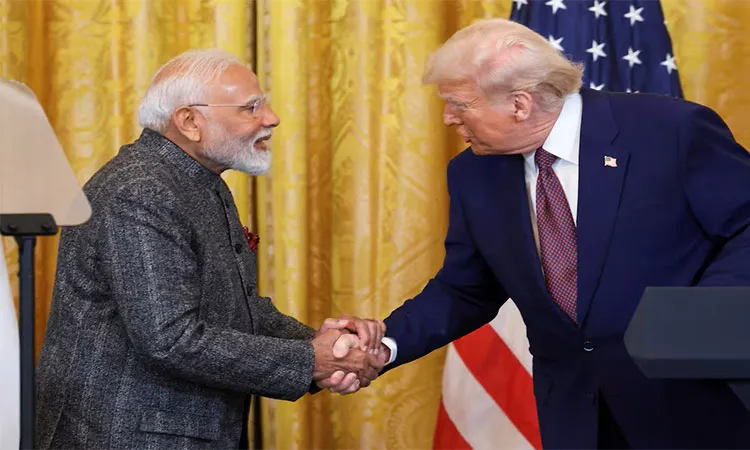
U.S. President Donald Trump on Monday announced a trade deal with India that cuts U.S. tariffs on Indian goods to 18%, down from 50%, in exchange for India ending its purchases of Russian oil and easing trade barriers.
Trump said the agreement followed a call with Indian Prime Minister Narendra Modi. He added that India would begin buying oil from the United States and may also source supplies from Venezuela.
A White House official told Reuters the U.S. would lift a punitive 25% duty imposed over India’s Russian oil purchases. That duty had been added on top of a separate 25% “reciprocal” tariff.
Markets reacted positively. U.S.-listed shares of major Indian firms rose sharply, with Infosys up 4.3%, Wipro gaining 6.8%, HDFC Bank climbing 4.4%, and the iShares MSCI India ETF up 3%. The announcement also boosted broader U.S. markets amid optimism around technology and artificial intelligence stocks.
Trump said Modi had committed India to “buy American at a much higher level,” including more than $500 billion in U.S. energy such as coal, as well as technology, agricultural, and other products. He also said India would reduce tariffs and non-tariff barriers on U.S. goods.
The announcement provided few details. Trump did not specify when the lower tariffs would take effect, when India would fully halt Russian oil purchases, or which trade barriers would be removed. By late Monday, the White House had not issued a presidential proclamation or a Federal Register notice needed to formalize the changes.
India’s commerce and foreign ministries did not immediately comment. Russia’s embassy in Washington also did not respond to requests for comment. Economists said the deal would bring India closer to tariff levels seen across Asia. “It puts India broadly in line with its Asian peers,” said Madhavi Arora of Emkay Global, adding that the move would ease pressure on Indian exports and the rupee.
India’s markets had struggled since the tariffs were imposed, making it the worst-performing major emerging market in 2025 due to heavy foreign investor outflows.
U.S. business groups offered mixed reactions. The U.S. Chamber of Commerce welcomed the announcement as progress toward a broader trade pact but said it would review the details. A coalition of small businesses warned the tariffs still represent a sharp increase compared with pre-2024 levels.
Modi welcomed the announcement, saying reduced tariffs would benefit Indian exporters. India’s Trade Minister Piyush Goyal said the deal would deepen economic ties and help India access U.S. technology.
The agreement follows months of tense negotiations and comes shortly after India signed a major trade deal with the European Union. It also reflects India’s gradual move away from Russian oil, which has supplied much of its discounted imports since Russia’s invasion of Ukraine in 2022.