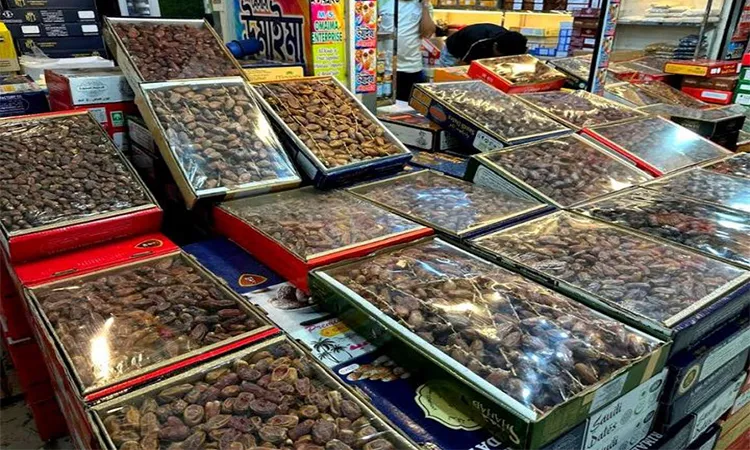
Despite the increase in imports and reduction in duty, the prices of most dates have increased this year in the run-up to Ramadan. This raises questions about who is getting the benefit of the large stock and low duty. As the holy month of Ramadan approaches, there is a skyrocketing demand for dates, an essential ingredient for iftar. Every year, capitalizing on this demand, a class of business syndicates increase prices on various pretexts.
With this in mind, the government has given a 10 percent duty exemption on imported dates to keep the market price tolerable and to provide relief to ordinary buyers. As a result, imports have also increased by about 23 percent compared to last year. But on Tuesday, just before the start of Ramadan, high prices were observed in the markets of Chittagong instead of tolerable prices.
To keep the Ramadan market stable, the National Board of Revenue (NBR) reduced the import duty on dates from 25 percent to 15 percent through a special notification on November 21.
This special facility will remain in force until March 31. This positive step of the government has seen great enthusiasm among importers. According to Bangladesh Bank data, a total of 14,420 tons of dates were released in the four months from October last year to January this year. This is 23 percent more than the import of 11,714 tons in the same period of the previous year.
According to the Chattogram Port and Importers Association, the country imported 7,897 tons more dates in 2024 than in 2023. According to the Bangladesh Fresh Fruits Importers Association, the country has a demand of 90 to 95 thousand tons of dates annually. About 70 percent of which is used during the month of Ramadan. Currently, about 80 percent of the country's demand is being met through dates imported from Iraq, Iran, Jordan, Egypt, Indonesia and Saudi Arabia. This time, the amount of date imports from Pakistan has also increased.
According to importer sources, the price of various varieties of dates, such as Ajowa, Maryam, Medjool, Mabrum, Amber, etc., including customs duties, has fallen to $ 3.75. In Bangladeshi taka, the price of which is 461 taka. In addition, the price of dates imported from Algeria and Tunisia has fallen to $ 2.60 (319 taka) including customs duties, and the purchase price of cartoned dates from Iraq has fallen to $ 2.50 (310 taka).
However, the price of Medjool and Ajowa dates in the retail market is now skyrocketing. It was found in the fruit market that Ajwa dates, which were sold for 640 to 800 taka last year, are now selling for over 1300 taka per kg. On the other hand, Medjool, known as the 'Queen of Dates', which was sold for 920 to 960 taka last year, is now being sold for 1750 taka. Even the price of soft dates in sacks, known as the hope of low-income people, has increased slightly compared to before. Dates in sacks that were available for 125-130 taka last year are now being sold for 175 taka.
Mahmudul Hasan, a buyer who came to shop at the fruit market, expressed his anger and said that even though the government reduced the duty, it could not break the syndicate in the market. Even though the price of dates is high throughout the year, at least during Ramadan, it should have been brought within the purchasing power of the common people. According to him, if government surveillance or market monitoring is not strong, the benefits of duty reduction will only remain in the pockets of importers. However, the prices of some varieties of dates including Zahidi, Iraqi Nagal Mabrum, Maryam, Kalmi have decreased compared to before in the wholesale market.
Proprietor of Messrs. Faria Dryfoot and Packaging Store in Fruit Mandi, Md. Abdur Rahim said that there is currently sufficient stock in the warehouse. There is no fear of a crisis. Therefore, he hopes that the prices will remain stable during Ramadan. Md. Abu Bakkar, Secretary of Religion and Social Welfare of the Chittagong Fruit Traders Association, said that due to the reduction in duty, small traders have also got the opportunity to import, which has increased competition in the market. Since there is sufficient stock, no trader will want to hold the product in the hope of additional profit, so there is no chance of an abnormal increase in the price of dates this time.