A series of recent earthquakes felt across Dhaka and other parts of the country has prompted the government to begin policy-level discussions on developing a long-term, integrated national earthquake preparedness strategy, with the capital city at the centre of the initiative.
Officials at the Ministry of Disaster Management and Relief said the proposed framework, being informally referred to as a “mega plan,” would draw on international best practices from earthquake-prone nations and focus on strengthening Bangladesh’s resilience against a potentially devastating seismic event.
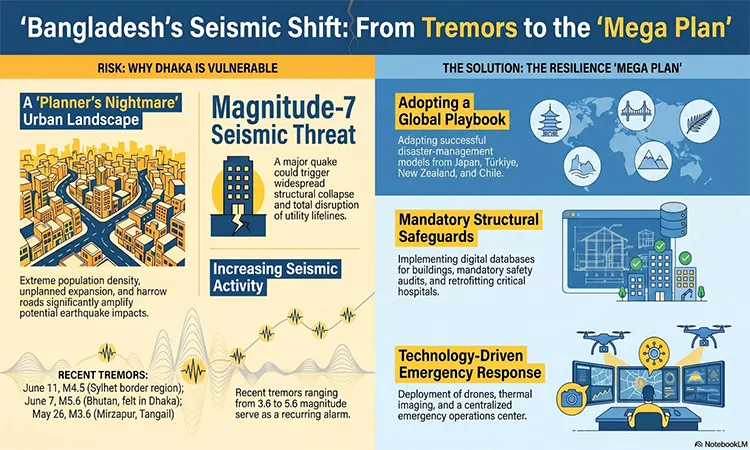
The move comes after several mild to moderate earthquakes were felt in and around Dhaka in recent months, reigniting concerns over the country's vulnerability to major seismic disasters.The latest tremor, measuring 4.5 on the Richter scale, struck on June 11 at approximately 9:40 p.m., with its epicentre located near the Sylhet border region. Earlier, on June 7, a 5.6-magnitude earthquake originating in Bhutan was felt across the capital. Other recent seismic events included a 3.6-magnitude tremor near Mirzapur in Tangail on May 26 and a 4.6-magnitude earthquake centred in Sikkim on February 26.
Although none of these incidents caused significant damage, experts warn that the repeated tremors serve as a reminder of Bangladesh’s location within an active seismic zone.
Dhaka Remains Highly Vulnerable
Seismologists stress that the recent earthquakes should not be interpreted as precursors to a major event. However, they underscore the persistent threat posed by several active fault systems surrounding Bangladesh. Dhaka has long been identified as one of the world's most vulnerable megacities to earthquake risk. Unplanned urban expansion, ageing and non-compliant buildings, narrow road networks, extreme population density and limited emergency response capacity could significantly amplify the impact of a powerful earthquake. Experts caution that a magnitude-7 or stronger earthquake occurring along a nearby fault line could trigger widespread structural collapse across the capital, potentially affecting thousands of buildings. Critical infrastructure—including electricity, gas, water supply and telecommunications networks—could suffer severe disruption, while secondary hazards such as fires may further complicate rescue operations. Emergency response efforts could also be hindered in many densely populated neighbourhoods where access for rescue vehicles remains limited..
Focus on Risk Reduction and Urban Resilience
According to officials familiar with the discussions, the proposed preparedness plan may include comprehensive seismic risk assessments of buildings throughout Dhaka, retrofitting of critical infrastructure, establishment of emergency response corridors and designation of open spaces as evacuation and shelter zones. The initiative is also expected to prioritise strengthening the earthquake resilience of hospitals, educational institutions, government facilities and utility infrastructure.
Policy planners are examining successful disaster-management models implemented in countries such as Japan, Türkiye, New Zealand and Chile, with the aim of adapting relevant measures to Bangladesh’s unique urban and socio-economic realities.
Md. Saidur Rahman Khan, Secretary of the Ministry of Disaster Management and Relief, said Bangladesh must adopt a long-term approach to earthquake preparedness similar to the capacity it has developed for managing cyclones and floods.
“Just as we have strengthened our ability to cope with cyclones and floods, we must also build long-term preparedness for earthquake risks,” he said. “The government is exploring multiple avenues to make Dhaka and other major cities safer and more resilient. Through greater public awareness, safer infrastructure and enhanced emergency response capabilities, potential losses can be significantly reduced.” He added that modern disaster management increasingly focuses on risk reduction before disasters occur rather than response after the fact.
“Our objective is to develop an effective preparedness framework by combining international experience, modern technology and local realities,” he said.
Technology-Driven Preparedness Measures
Officials involved in the planning process said future initiatives could include the creation of a digital database of vulnerable buildings, mandatory structural safety audits, expanded earthquake drills, specialised urban search-and-rescue units and the deployment of advanced technologies such as drones and thermal imaging systems during emergency operations.
The establishment of an integrated emergency operations centre is also under consideration to improve coordination among government agencies and first responders during major disasters.
A Model for the Nation
Disaster-management specialists argue that while earthquakes cannot be prevented, their human and economic toll can be substantially reduced through resilient construction practices, effective urban planning and rapid emergency response mechanisms.
They believe a comprehensive earthquake preparedness programme centred on Dhaka could eventually serve as a national model for other metropolitan areas and district towns.
As Bangladesh continues to urbanise at a rapid pace, policymakers and experts alike view proactive earthquake preparedness as an increasingly urgent priority. A well-designed national strategy, they argue, would not only help minimise casualties and damage during a major earthquake but also ensure the continuity of essential public services and emergency operations in its aftermath. Such a framework could mark a significant step toward building a more disaster-resilient Bangladesh.