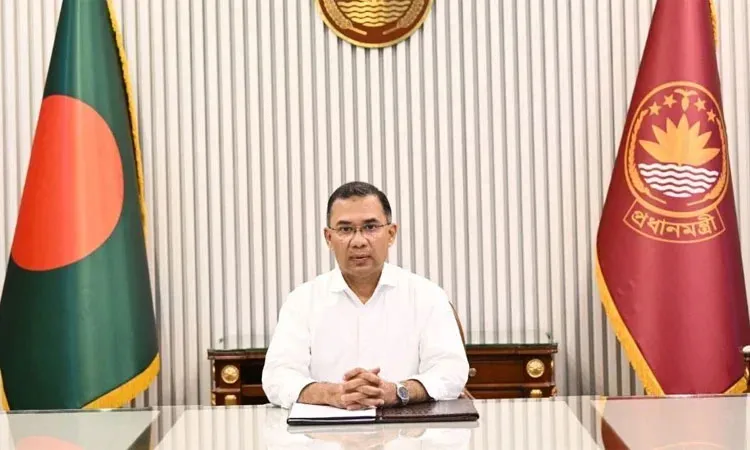
Prime Minister Tarique Rahman stated on Tuesday that the July Mass Uprising belongs neither to any single political party nor to an individual, emphasizing that the credit for its success goes entirely to the people.
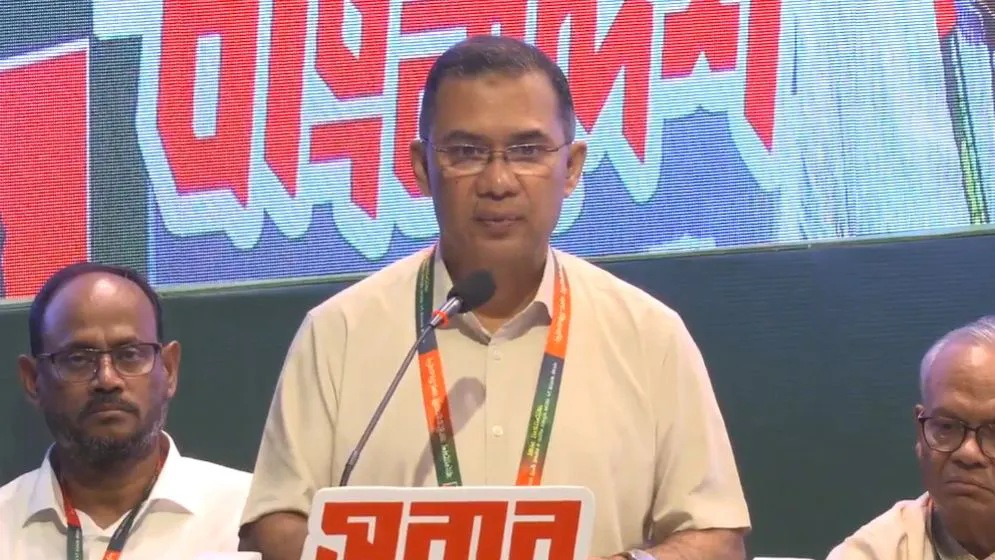
He made these remarks while addressing a discussion titled "17 Years of Unyielding Struggle for Democracy and the Blood-soaked July Awakening" at the Krishibid Institution in the capital on Tuesday afternoon (August 4).
"Various statements have been made at different times to mislead people regarding the July movement. From our side, we have stated clearly that the credit for the July movement belongs to the people of this country. It is not the credit of any single individual or political party," the head of government said. "We remained on the ground for the past 17 years and never abandoned the field or left the public alone."
Highlighting historical parallels, he noted that world history shows movements build gradually over time until the masses join in. "The same happened in July and August. The movement succeeded because the people wanted change," he added.
Addressing structural reforms, Prime Minister Tarique Rahman recalled, "When we first started speaking about reforms, no other political party in Bangladesh was discussing the topic. Our reform proposals progressively materialized into the 31-point outline." He pointed out that during the regime of the previous fascist government, an estimated $16 billion was siphoned out of the country annually.
He further stated that the fascist regime devastated key sectors, including banking, healthcare, and agriculture. "We understand that the public is enduring hardships amidst this shattered state. We are doing everything within our power to help the people recover from this devastating situation," he assured.
Turning to the health sector, the Prime Minister expressed concern over long-standing systemic gaps: "It is surprising that even so long after independence, we could not install kidney dialysis machines at the upazila level. You will be glad to know that within the next 3 to 6 months, 50-bed dialysis units will be established in most district-level medical colleges, and 10-bed units in general hospitals. Furthermore, 10-bed dialysis facilities will be introduced at the upazila level within the next 2 to 3 years."