A two-day programme is being observed at Jatiya Kabi Kazi Nazrul Islam University (JKKNIU) marking National Revolution and Solidarity Day.
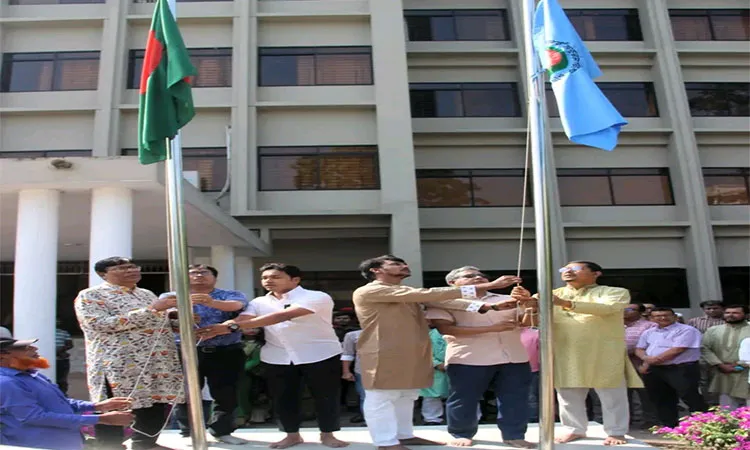
On the first day of the programme, the national flag and the university flag were hoisted in front of the university's new administrative building on Saturday morning (November 7) to the national anthem.
Treasurer Professor Dr Mohammad Emdadul Huda hoisted the national flag as the chief guest, while the university flag was hoisted by the deans of different faculties.
Following the flag hoisting, a brief discussion was held highlighting the historical context of November 7, 1975, the significance of the day in national life, and the importance of national unity and solidarity.
Speaking as the chief guest, Professor Dr Mohammad Emdadul Huda said, "Understanding the significance of National Revolution and Solidarity Day requires knowledge of its historical context. The people of the country achieved independence in 1971 with certain hopes and aspirations. However, a gap between those expectations and their fulfilment emerged in the following years, leading to public discontent. Following the assassination of then President Sheikh Mujibur Rahman on August 15, 1975, instability emerged in the country's governance. Discipline and the chain of command within the army broke down.
"On November 3, 1975, then army chief Major General Ziaur Rahman was placed under house arrest following a coup led by Major General Khaled Mosharraf. An abnormal situation prevailed in the country at the time. Ordinary people had no clear understanding of the administrative situation, while the media were not publishing reports on the matter. Later, on November 7, Ziaur Rahman was freed through a united revolution and counter-coup by soldiers and civilians. According to his account, the soldiers and civilians participating in the movement freed him and celebrated the event.
"The chief guest further said that the combined efforts of the army and the people could change the course of a country. This was reflected in the 1971 Liberation War, the soldiers-and-people revolution of November 7, 1975, and the mass movement of 2024. The significance of National Revolution and Solidarity Day will be truly realised when everyone works together to build the country into a better place."
The programme was chaired by Professor Md Tanzil Hossain, convener of the day’s celebration committee and dean of the Faculty of Social Science.
Among others present were Professor Dr Md Raju Ahmed, dean of the Faculty of Business Administration; Professor Dr Ahmed Shakil Hashmi, dean of the Faculty of Law; Acting Registrar Khandaker Nazmul Hasan; Professor Dr A H M Kamal, director of the Institutional Quality Assurance Cell (IQAC); Professor Dr Md Saiful Islam, provost of Bidrohi Hall; Professor Dr Md Habib-ul-Mawla (Mawla-Prince), head of the Department of Bangla Language and Literature; Professor Dr Bakhtiar Uddin, head of the Department of Economics; and Proctor Dr Md Mahbubur Rahman. Heads of different departments, office chiefs, teachers, officials and students were also present.
The programme was conducted by Professor Dr Md Ashraful Alam, director of the Office of Student Counselling and Guidance. Habibur Rahman Habib, convener of the university unit Jatiyatabadi Chhatra Dal, and member secretary Mamun Sarkar also spoke at the event.
It is worth mentioning that a larger-scale discussion meeting will be organised at the university on November 12 (Thursday) as part of the observance.