- National
- Bangladesh
- Business
- International
- Sports
- Entertainment
- Politics
- Technology
- Life Style
- Religion
- Opinion
Sunday, 05 April 2026

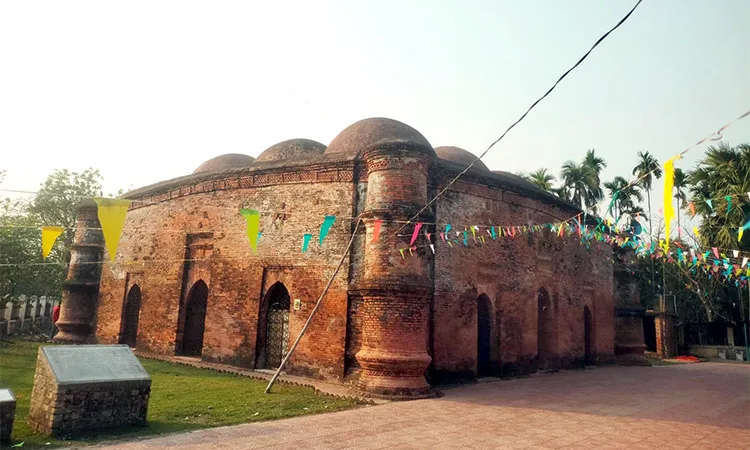
The historical Masjidkun Mosque, located in Masjidkun village of Amadi Union in Koyra Upazila, Khulna, has stood for centuries on the banks of the Kapotaksh River. Situated near the Sundarbans, approximately 95 kilometers south of Khulna town, the mosque continues to attract worshippers from Koyra, Paikgachha, and neighboring Ashasuni Upazila.
Before the Jumma prayer, the mosque premises fill with devotees. After every Friday prayer, special supplications are offered for the peace and prosperity of the nation and the global Muslim community. Idris Ali, a visitor from Ashasuni, said, “I try to come here at least once a year. Praying at this mosque during Ramadan brings me great peace. It is known as the mosque of the Pir, and I feel spiritually uplifted here.”
The mosque features nine domes, supported by four brick pillars. Built with lime-surki and thin square bricks, the mosque measures 16.76 meters on each side, with an interior length of 12.19 meters. The pillars divide the interior into nine equal squares, each crowned with a dome. A semicircular mihrab faces the Qibla, while a large entrance and unique architectural style draw visitors.
Though there is no inscription indicating its exact construction date, the mosque’s style resembles that of the Sixty-Domed Mosque, suggesting it was built during the era of Hazrat Khan Jahan Ali (RA). Currently, the Department of Archaeology of the Government of Bangladesh oversees its preservation.
Historical records indicate that Jalal Uddin Muhammad Shah was the Sultan of Bengal from 1418 to 1433. During this period, Khan Jahan Ali (RA) sent his followers to the south, and it is believed that Masjidkun Mosque was built around 1445 under the initiative of his companions Borhan Khan (Bura Khan) and Fateh Khan.
Local resident Zulfiqar Ali noted that the mosque remains cool even in extreme heat. The Kapotaksh River flows along the southwest side, and visitors climb stairs from the embankment to enter the mosque. Imam Md. Amirul Islam said that devotees gather from far and wide, especially during Ramadan. Earlier practices linked to superstition have been discontinued. Visitors, including SM Alauddin Sohag, Abul Hashem, and Sheikh Mamunur Rashid from Paikgachha, highlight that the mosque is not only a place of worship but also an important example of Muslim architectural heritage in southern Bangladesh. Locals urge the government to further renovate and enhance the mosque.
Comment