


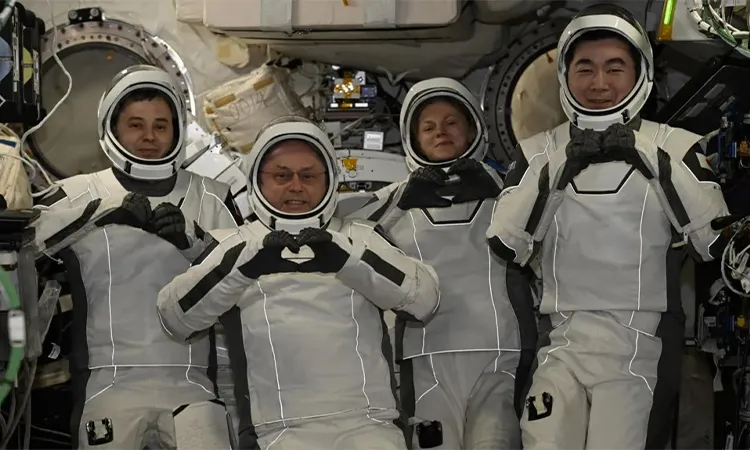
In an unprecedented move for the International Space Station (ISS), four astronauts have begun an early journey home following the first-ever medical evacuation in the station’s 26-year history.
The "Crew-11" team—comprising NASA’s Mike Fincke and Zena Cardman, Japan’s Kimiya Yui, and Russian cosmonaut Oleg Platonov—undocked their SpaceX Dragon capsule on Wednesday. They are expected to splash down off the coast of California early Thursday morning local time.

The mission, which began on 1 August, was originally scheduled to last until mid-February. However, NASA decided to bring the entire team home a month early after a "serious medical issue" affected one crew member on 7 January.
While NASA has not disclosed the identity of the ill astronaut or the nature of the condition due to privacy, officials confirmed the individual remains in stable condition. NASA Administrator Jared Isaacman noted that the decision was made because the specialized equipment needed for a full diagnosis is not available on the orbiting lab.
Before departing, veteran astronaut Mike Fincke handed over control of the ISS to Russian cosmonaut Sergey Kud-Sverchkov. In a "bittersweet" ceremony on Monday, Fincke reassured the public via social media that all crew members are "stable, safe, and well cared for."
The departure leaves the ISS with a "skeleton crew" of just three—NASA’s Chris Williams and Russian cosmonauts Sergey Kud-Sverchkov and Sergei Mikaev. They will manage the station alone until the next four-person crew arrives in February.
Medical evacuations from space are extremely rare. Similar incidents occurred only twice during the Soviet era: once in 1985 from the Salyut 7 station and again in 1987 from the Mir station.
As space agencies plan longer missions to the Moon and Mars, experts suggest that including doctors as permanent crew members may soon become a necessity for human spaceflight.

