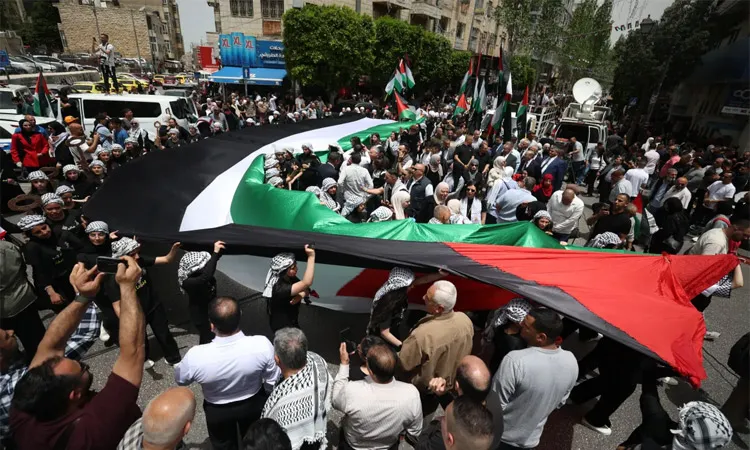
The Nakba, Arabic for “catastrophe” is refers to the mass expulsion and flight of around 750,000 Palestinians from their homes during the 1948 war surrounding Israel's creation. Between 1947 and 1949, Zionist paramilitary groups captured Palestinian towns and villages, depopulating or destroying more than 400 neighborhoods to make way for new Jewish immigrants.
For many Palestinians, the current destruction and displacement underscore a bitter reality: the Nakba is not a sealed historical event, but an ongoing process of dispossession. Activists and survivors maintain that marking the anniversary is both an act of remembrance and a renewed demand for justice, return and self-determination.
Today, those refugees and their descendants number in the millions, living in camps across the occupied West Bank, Gaza, Jordan, Lebanon, and Syria. Many still hold onto the keys, deeds, and documents of their ancestral homes, passing them down as symbols of their UN-enshrined "right of return" under General Assembly Resolution 194.
This year's anniversary arrives amid the devastating, protracted conflict in Gaza. More than two million people in the besieged enclave remain displaced, crammed into less than half of the 40-kilometer (25-mile) strip along the Mediterranean coast, hemmed in by Israeli military zones.
Iran has reiterated its support for the Palestinian right to self-determination, calling on the international community to halt what it described as an ongoing genocide in Gaza as millions mark the 78th anniversary of the Nakba.
In a statement released Saturday, the Iranian Ministry of Foreign Affairs said the "catastrophic consequences" of the 1948 occupation of Palestine continue to destabilize West Asia and the wider world. The ministry condemned the establishment of the Israeli state nearly eight decades ago, labeling it the start of one of the modern era's gravest human and moral tragedies.
Supported by Western allies including the US, Britain, Canada, and Germany, the "occupying regime" has committed severe violations of international law, the statement added. Tehran also accused Washington of shielding Israeli leaders from prosecution by exerting unlawful pressure on international courts, making successive US administrations complicit in the crisis.
Iran reaffirmed the Palestinian right to resist occupation and apartheid, while categorically rejecting any plans for the forced displacement of Palestinians from Gaza and the West Bank.