- National
- Bangladesh
- Business
- International
- Sports
- Entertainment
- Politics
- Technology
- Life Style
- Religion
- Opinion
- FIFA World Cup 2026
Tuesday, 07 July 2026

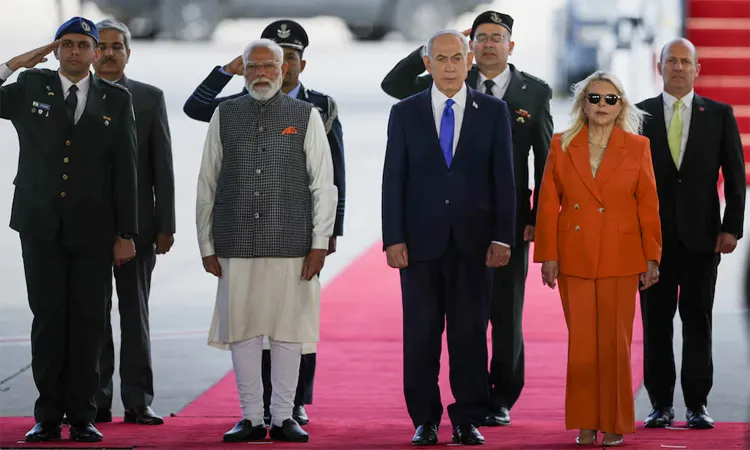
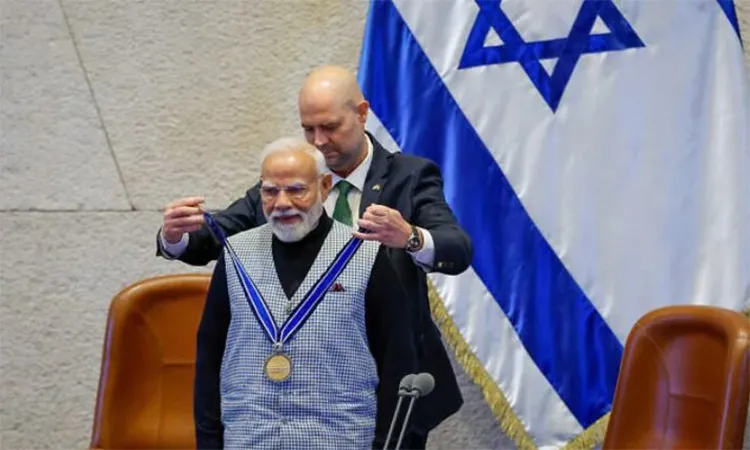
India’s Prime Minister Narendra Modi arrived in Israel on Wednesday for a two-day visit aimed at deepening bilateral relations, as tensions rise in the Middle East over a possible military conflict between the United States and Iran.
Modi made history in 2017 by becoming the first Indian prime minister to visit Israel. During that trip, he was hosted by Israeli Prime Minister Benjamin Netanyahu, with whom he shares close personal ties. Both leaders remain in office and are expected to hold talks on defence cooperation and artificial intelligence during the visit, at a time when Israel is seeking to expand its military exports.
An Israeli government official said the visit would open doors to new partnerships across several sectors, while a foreign ministry official described bilateral relations as being on the verge of a major upgrade.
During the visit, Modi is expected to address Israel’s parliament, the Knesset, and lay a wreath at Yad Vashem, the country’s official Holocaust memorial.
The trip comes against the backdrop of heightened regional uncertainty. The United States has deployed major naval assets near Iran amid stalled talks over Tehran’s nuclear programme. Analysts warn that any US strike on Iran could trigger retaliation against Israel and US military facilities in Gulf countries, where millions of Indians live and work and send home significant remittances.
Kabir Taneja of the Observer Research Foundation said India wants to avoid further instability in the region. He noted that New Delhi has consistently conveyed its preference for de-escalation and is likely to repeat that message during Modi’s visit.
Israeli officials said regional issues are also expected to feature in discussions. Speaking earlier this week, Netanyahu described India as part of a future group of like-minded nations working together against what he termed radical forces in the region.
Taneja added that while India is keen to purchase Israeli defence equipment, it is unlikely to join any formal military alliance, given its long-standing policy of non-alignment.