- National
- Bangladesh
- Business
- International
- Sports
- Entertainment
- Politics
- Technology
- Life Style
- Religion
- Opinion
Wednesday, 03 June 2026

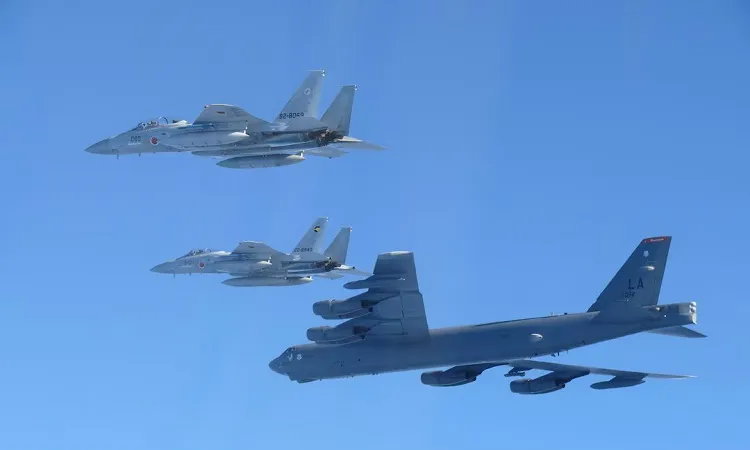
The United States deployed nuclear-capable B-52 strategic bombers to fly over the Sea of Japan alongside Japanese fighter jets on Wednesday, in a direct military response following joint air and sea drills conducted by China and Russia near Japan and South Korea.
Two U.S. B-52 bombers flew with three Japanese F-35 stealth fighters and three F-15 jets. Japan's defense ministry stated the joint exercise "reaffirmed their strong resolve to prevent any unilateral attempt to change the status quo by force."
The U.S.-Japan flight was the first major military assertion by the U.S. since China began its military exercises in the region last week, including a joint strategic bomber flight with Russia in the East China Sea and Western Pacific on Tuesday.
Japanese Chief of Staff, Joint Staff General Hiroaki Uchikura, called the China-Russia joint bomber flight "clearly a show of force directed at Japan" and a "grave concern" for Japan's security.
Earlier tensions flared after China conducted separate aircraft carrier drills, during which Japan scrambled jets that Tokyo alleged were targeted by radar beams—an accusation China denied.
Tensions were already high after Japanese Prime Minister Sanae Takaichi suggested last month that a Chinese attack on Taiwan could trigger a military response from Tokyo. On Thursday, Taiwan reported a stepped-up Chinese military presence, including 27 aircraft and nuclear-capable H-6K bombers, conducting a "joint combat readiness patrol."
An anonymous U.S. official downplayed the timing of the bomber flights, claiming they were pre-planned before the Chinese-Russian drills and noting similar joint sorties occurred last month.
White House spokeswoman Karoline Leavitt affirmed that President Donald Trump can maintain a "good working relationship" with Chinese President Xi while upholding a "very strong alliance" with Japan.
The State Department criticized China's recent military actions as "not conducive to regional peace and stability" and reiterated that the U.S. alliance with Japan is "unwavering."
Chinese Foreign Ministry spokesperson Guo Jiakun dismissed Japan's concerns, stating the drills with Russia were part of an annual plan to "safeguard regional peace and stability" and that "The Japanese side has no need to make a fuss about nothing."
South Korea's military also scrambled fighter jets when the Chinese and Russian aircraft entered its air defense identification zone on Tuesday.