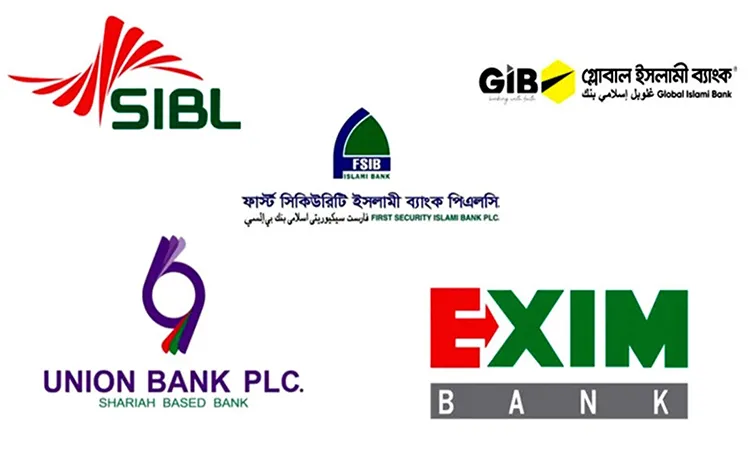
Sammilito Islami Bank, the newly formed entity resulting from the merger of five Islamic banks—Exim Bank, First Security Islami Bank (FSIBL), Social Islami Bank (SIBL), Union Bank, and Global Islami Bank—is set to conduct a feasibility study to decide the future of its various subsidiaries.
According to the Bangladesh Bank (BB), the merged entity will retain subsidiaries with strong business prospects while potentially liquidating or merging underperforming ones to ensure operational profitability.
The decision-making process primarily affects Exim, FSIBL, and SIBL, as Union Bank and Global Islami Bank do not currently own subsidiaries. Key highlights include:
A major brokerage firm with a paid-up capital of Tk 1.98 billion and 3,000 clients. Despite market volatility, it reported an operating profit of Tk 77 million in 2024 and is expected to sustain operations.
A merchant bank awaiting a license with unutilized capital; it is a prime candidate for liquidation or a merger.
There are indications that the merchant banks of FSIBL, Exim, and SIBL could be consolidated into a single, stronger entity.
The Bangladesh Securities and Exchange Commission (BSEC) clarified that since subsidiaries are separate legal entities, they will continue day-to-day operations under existing rules until a final decision is reached by the parent bank. SIBL Securities recently had its license renewed by the regulator.
Sammilito Islami Bank faces the monumental task of managing the distressed assets of its predecessors. Approximately 90% of the loans and advances from the troubled banks are classified as non-performing.
The bank’s leadership, supported by the central bank, emphasized that the institution will operate as a profit-driven entity rather than a charity, focusing on recovering these bad loans to stabilize the Islamic banking sector.