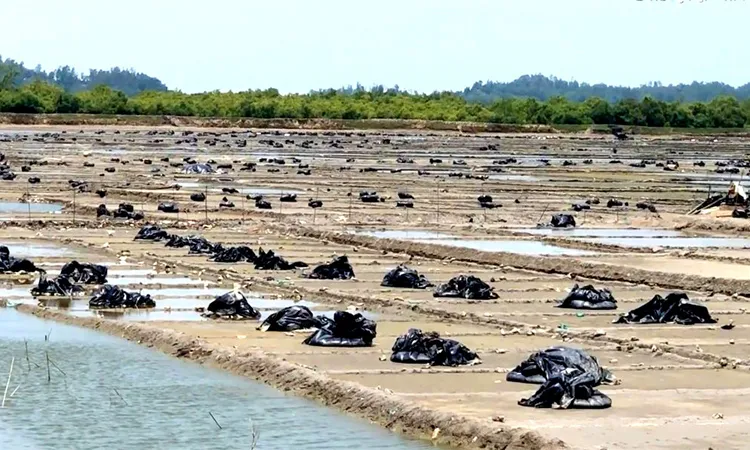
The coastal salt-producing region of Cox’s Bazar has suffered severe damage from sudden Kalbaishakhi storms and heavy rain over the past two days. Thousands of acres of salt fields were flooded, washing away large amounts of harvested salt and disrupting production during the peak season.
According to the Bangladesh Small and Cottage Industries Corporation (BSCIC), around 68,000 acres of salt fields have been affected. Officials fear that production of nearly 100,000 metric tons of salt could be lost due to the disaster.
Cox’s Bazar produces about 95 percent of the country’s salt. Salt farming in the region depends heavily on sunlight and dry weather, as sea water is evaporated naturally in open fields.
Despite difficult weather earlier in the season, recent heatwaves had increased daily production from around 12,000 metric tons to nearly 32,000 metric tons. However, continuous rain and strong winds have now halted production in many areas. Large quantities of stored salt have melted into water, while many fields remain waterlogged.
BSCIC officials said repeated rainfall this month has already slowed production, and the latest storms may make it difficult to meet this season’s target.
Affected farmers are now trying to drain water from the fields and repair damaged polythene sheets and salt beds. Many said they had invested through loans and are now facing serious financial hardship.
Farmers warned that if weather conditions do not improve soon and government support is delayed, the country could face a salt supply shortage.
This season, salt cultivation took place on 68,505 acres across Cox’s Bazar Sadar, Kutubdia, Maheshkhali, Pekua, Chakaria, Eidgaon, Teknaf and parts of Banshkhali in Chattogram.
So far, production has reached 1,373,272 metric tons, which is about 449,000 tons lower than the same period last season. Last season’s production during the same period stood at 1,822,162 metric tons. The target for this season is 2.81 million tons, while annual national demand is around 2.735 million tons.
Assistant Meteorologist Md Abdul Hannan of the Cox’s Bazar Meteorological Office said low pressure over the Bay and westerly winds caused the unstable weather. He said heavy rainfall and stronger sea waves allowed saline water to enter coastal salt fields. More rain is possible over the next few days, and farmers have been advised to remain cautious.
Reports from Maheshkhali, Chaufaldandi, Kutubdia, Pekua, Matarbari, Hoikyang and Shahparirdwip show extensive damage to salt beds and production infrastructure. Areas that usually hold piles of white salt are now submerged under rainwater.
Industry insiders estimate that nearly 40,000 workers have become temporarily unemployed because production has stopped in many areas.
Salt farmer Nurul Islam from Chaufaldandi said it may take at least a week to resume production. “Hundreds of tons of salt dissolved in rainwater within an hour,” he said.
Another farmer, Gias Uddin of Khurushkul, said production stopped on hundreds of acres after Saturday’s rainfall. He also complained that low market prices have forced farmers to sell salt at a loss for months.
Ali Ahmed from Matarbari said he had borrowed money to continue farming this season. “The rain destroyed everything at the end of the season. Now I do not know how I will repay my loans,” he said.
Abu Shama, owner of the Gomatli salt mill, warned that the disruption could affect the supply of salt needed for preserving rawhide during Eid-ul-Azha. He said around 350,000 metric tons of salt are required nationwide for leather preservation during the Qurbani season.
Md Zafar Iqbal Bhuiyan, Deputy General Manager of the Cox’s Bazar Salt Industry Development Office, said authorities are collecting information from affected farmers and monitoring the situation closely.
Experts say increasingly irregular weather linked to climate change could pose a long-term threat to Bangladesh’s salt industry, making sustainable planning and farmer support more important than ever.