
- National
- Bangladesh
- Business
- International
- Sports
- Entertainment
- Politics
- Technology
- Life Style
- Religion
- Opinion
- FIFA World Cup 2026
Sunday, 14 June 2026

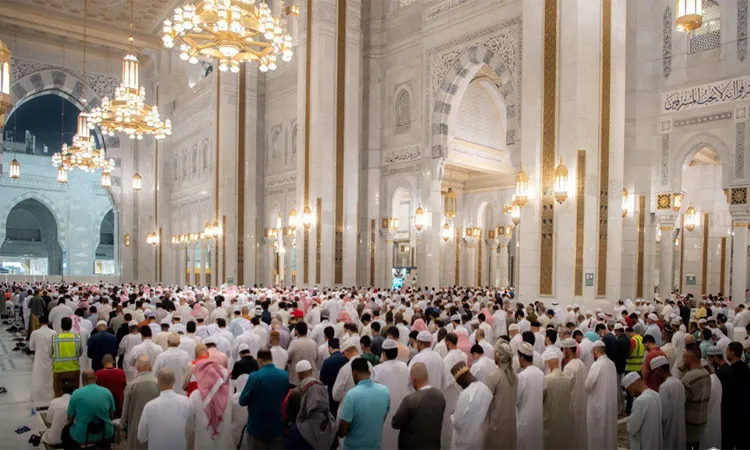
The month of Ramadan is a great blessing for believing Muslims, bestowed by Allah Almighty and taught by the beloved Prophet Hazrat Muhammad (PBUH). Every moment of this sacred month is filled with opportunities for worship. Some acts of worship are unique to Ramadan, and among them, Tarawih prayer holds a special place.
Tarawih prayers are performed only during the nights of Ramadan. The Arabic word Tarawih means comfort and tranquility. It reflects the calm and devotion with which this prayer should be offered.
Hazrat Abu Hurairah (RA) narrated that the Prophet (PBUH) said: “Whoever stands in prayer during the nights of Ramadan with faith and seeking reward, his past sins will be forgiven.” This hadith is recorded in Sahih Bukhari and Sahih Muslim.
Another narration found in Sunan an-Nasa’i and Musnad Ahmad states that fasting during Ramadan and standing in prayer with sincerity leads to forgiveness of sins, as pure as the day one was born.
According to narrations recorded by Imam Bayhaqi and Imam Tirmidhi, Hazrat Abdullah ibn Abbas (RA) said that the Prophet (PBUH) performed 20 rak‘ahs of Tarawih. However, the Prophet did not regularly lead Tarawih in congregation, fearing that it might become obligatory for the Ummah, which could cause hardship. Out of mercy, he encouraged the prayer without making it compulsory.
In recent years, debates over the number of rak‘ahs of Tarawih have increased in Bangladesh. Such disputes were rare in the past. According to the consensus of Ahl-e-Sunnah wal Jama‘at—including the Hanafi, Shafi‘i, Maliki and Hanbali schools—Tarawih of 20 rak‘ahs is Sunnah Mu’akkadah (an emphasized Sunnah).
Different Islamic groups hold differing views. Shia Muslims do not observe Tarawih in congregation, while some Salafi and Ahl-e-Hadith followers perform eight rak‘ahs. Despite this diversity, for centuries the Muslim Ummah has practiced Tarawih with unity and respect for scholarly differences.
Even in the Haramain Sharifain, Tarawih has traditionally been performed with great care. Temporary adjustments in rak‘ahs during exceptional situations, such as the Covid-19 period, were made due to special circumstances, followed by long congregational night prayers later.
It is the established practice of the Companions to complete at least one full recitation (Khatam) of the Holy Quran during Tarawih. More recitations are virtuous, but clarity and correct pronunciation (makhraj) are essential. If recitation is rushed or unclear, the prayer itself may be affected. Therefore, Tarawih should always be performed calmly and attentively.
During Ramadan, mosques come alive with worshippers of all ages. The atmosphere becomes spiritual and uplifting. Sadly, once Ramadan ends, many mosques fall silent. It must be remembered that while Tarawih is Sunnah, the five daily prayers are obligatory. Greater importance must be given to performing them regularly, especially in congregation.
If we remain mindful and consistent, our mosques can stay vibrant throughout the year. May Allah grant us sincerity and steadfastness. Ameen.
Author: Mohammed Nurul Absar Taiyobi is a writer, researcher, and Islamic thinker. He is the Founder President of the Expatriate Journalists Association (PRASAS) based in Dubai, UAE. Additionally, he serves as the Chairman of the Islamic Research Center located in Abu Dhabi, UAE. For correspondence, he can be reached at: muntyping@gmail.com
