


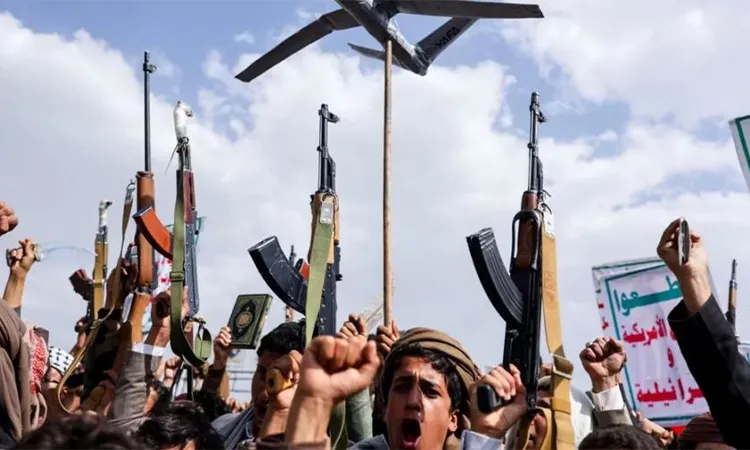
Yemen's Houthi rebels claim to have launched missile attacks on Israel, warning that Israeli-linked commercial ships in the Red Sea will once again be targeted.
Brigadier General Yahya Saree, the group's military spokesman, announced the strikes in a video broadcast on the Al-Masirah television network on Monday, June 8. This escalation worsens Middle East tensions and threatens the fragile April 8 ceasefire amid ongoing airstrikes between Iran and Israel.

The renewed threats endanger commercial shipping across the Red Sea, the Gulf of Aden, and the narrow Bab al-Mandab Strait. During the height of the Gaza war, the Houthis launched over 100 attacks in these waters—killing at least nine sailors and sinking four ships. These strikes severely disrupted a vital maritime route that historically handles nearly $1 trillion in annual global trade.
While the Houthis recently focused on domestic rebuilding and peace talks with Saudi Arabia to avoid direct involvement in broader US-Iran conflicts, they have now claimed a direct strike on the Israeli city of Jaffa.
In a formal statement, the Houthi leadership—also known as Ansar Allah—declared: “We declare a complete and absolute ban on maritime navigation for the Israeli enemy in the Red Sea. From this moment, any enemy movement will be considered a military target.” They emphasized that any aggression would trigger a strong response, carried out in coordination with the regional "Axis of Resistance."
Meanwhile, Ali Akbar Velayati, an advisor to Iran's Supreme Leader, warned adversaries against miscalculations, noting that resistance forces possess the capability to close key waterways if provoked. A simultaneous closure of the Strait of Hormuz and the Bab al-Mandab Strait would severely cripple global trade between the East and West.

In related developments, Tehran confirmed that recent Israeli airstrikes damaged Iran's Qarun Petrochemical Company in a special economic zone. No casualties have been reported, but damage assessments are ongoing.
Iranian Foreign Minister Abbas Araghchi spent the night speaking with global diplomats—including his counterparts from the UK, Turkey, and Saudi Arabia—to outline Iran's rationale for resuming military operations against Israel in the current security climate.

