An internal Bangladesh Bank (BB) document has exposed the banking sector's massive vulnerability to defaulted loans linked to six major business conglomerates.
The confidential analysis raises alarms over the country's financial stability and the asset quality of several top-tier banks.
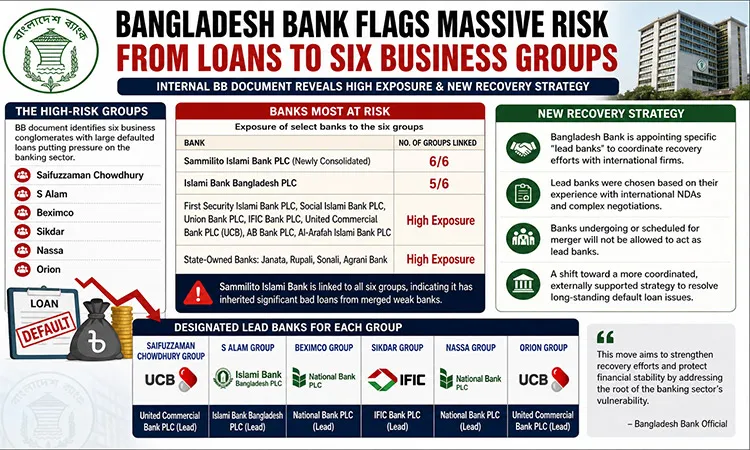
The document, titled “Selected Lead Banks, Impacted by Six Groups,” identifies the high-risk groups as: Saifuzzaman Chowdhury, S Alam, Beximco, Sikdar, Nassa, and Orion.
Banks Most at Risk
The data reveals that Islami Bank Bangladesh PLC is involved with five of the six identified groups. Meanwhile, the newly consolidated Sammilito Islami Bank PLC is listed under all six, suggesting it has inherited a significant volume of bad loans from merged weak banks.
Other heavily exposed institutions are First Security Islami Bank, Social Islami Bank, Union Bank, IFIC, United Commercial Bank (UCB), AB Bank, and Al-Arafah Islami Bank and State-Owned Banks: Janata, Rupali, Sonali, and Agrani Bank.
New Recovery Strategy: 'Lead Banks' Assigned
To tackle this systemic risk, Bangladesh Bank is appointing specific "lead banks" to coordinate recovery efforts alongside international firms. These lead banks were chosen based on their experience with international non-disclosure agreements (NDAs) to handle complex negotiations.

The designated lead banks for each group are:
Saifuzzaman Chowdhury Group: United Commercial Bank PLC (Lead)
S Alam Group: Islami Bank Bangladesh PLC (Lead)
Beximco Group: National Bank PLC (Lead)
Sikdar Group: IFIC Bank PLC (Lead)
Nassa Group: National Bank PLC (Lead)
Orion Group: United Commercial Bank PLC (Lead)
The central bank has clarified that any bank currently undergoing or scheduled for a merger will not be allowed to act as a lead bank. Officials stated this move marks a shift toward a more coordinated, externally supported strategy to resolve long-standing default loan issues that have plagued the sector for years.