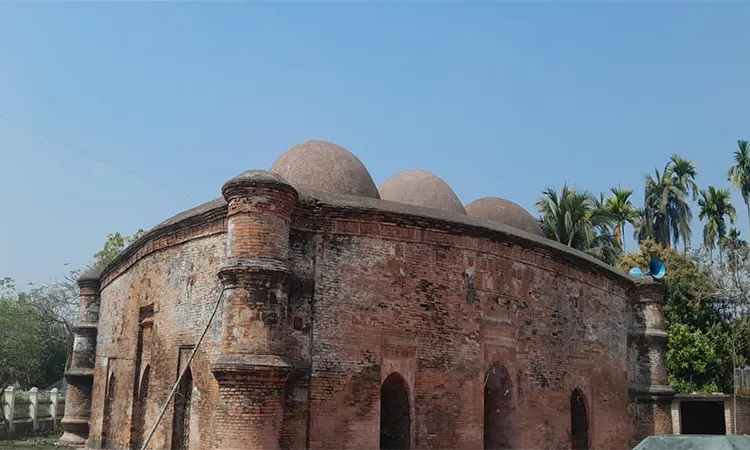
In Masjidkun village of Koyra, a coastal area of Khulna, an ancient mosque continues to bear witness to centuries of history. The Masjidkun Mosque is a significant example of Bengal’s Sultanate-era architecture and an important marker of religious and cultural expansion in the southwest.
The mosque is located in Amadi Union of Koyra Upazila, about 90 kilometres from Khulna city. It stands just east of the Kapotaksha River, which flows beside Masjidkun village.
Built between the 13th and 16th centuries during the Sultanate period, the mosque has undergone several renovations over time. Local residents say the historic structure now requires proper conservation and maintenance under government supervision to preserve its heritage value.

According to local accounts, between 1450 and 1490, Bura Khan and Fateh Khan—disciples of Khan Jahan Ali—established a kachari (administrative centre) in Amadi village and governed the area. During that period, they are believed to have built the mosque.
The mosque complex once covered about 45 acres, making it one of the oldest brick-built religious structures in southern Bengal. To the south of the mosque were the kacharibari and the tombs of Bura Khan and Fateh Khan. These structures were gradually destroyed by floods and natural disasters.
At one point, the mosque itself was submerged, and the surrounding area turned into dense forest. Locals said people avoided the site for years. In the early 20th century, however, the mosque was rediscovered and restored through extensive renovation efforts.
Architecturally, the mosque is square in shape, with each side measuring about 16.76 metres. The inner prayer space measures approximately 12.19 metres on each side. There are three entrances on the north, east and south walls, while the western wall faces the qibla. The central entrances are larger than the others, reflecting typical Sultanate-era design.
Historians and residents say Masjidkun Mosque remains a valuable symbol of Bengal’s medieval Islamic architecture and deserves systematic preservation for future generations.