The women who started agricultural work in the past are still involved in agricultural work. Not only agricultural work, the scope of work of female workers has increased day by day. But their wages have not increased. Due to various neglects, women are getting involved in various jobs in order to live independently rather than being dependent.
In addition to agricultural work, women in the Sariakandi area are also working in rural infrastructure development (construction of road ghats), chili mills, rice mills, hotels, restaurants, brick kilns and even construction workers. They are forced to join the sale of labor to survive after eating at high prices in the market. But while selling this labor, they are victims of various types of neglect. Along with this, women are deprived of proper remuneration.
Sariakandi is an agricultural-based upazila of Bogra district. There are no factories or industrial establishments here. Agriculture is the only source of income for the people of this upazila. Most of the farmers here live below the poverty line.
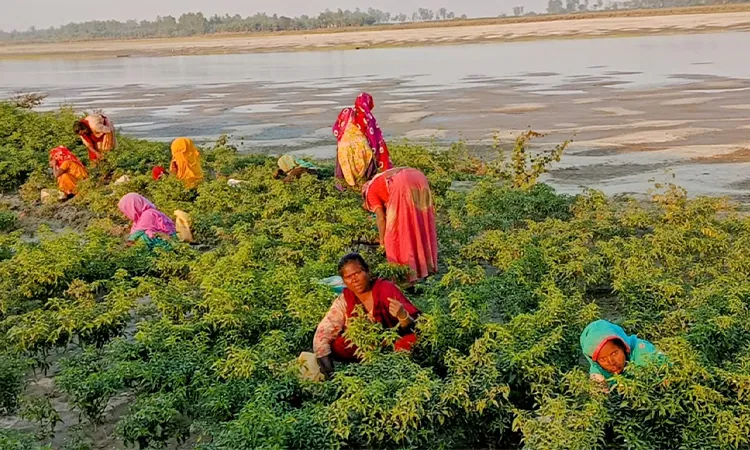
When you go to the agricultural land of the char area, you can see the hot sand and turbulent waves of the Jamuna stretching to the horizon. There, a group of women are busy picking chili peppers in the harsh morning sun. Such a scene is now a daily occurrence in the Jamuna-dominated char areas of Sariakandi, Bogra. The women of the 117 chars of this upazila are now revolutionizing agriculture shoulder to shoulder with men. The wheels of the village economy are mainly driven by their labor, and the prosperity of the family is returning.
According to the Upazila Agriculture Office, 6 out of 12 unions of Sariakandi are mainly surrounded by the Jamuna River. The main livelihood of these remote chars is agriculture. Earlier, only men used to work in the fields in these areas, but that picture has changed in the last few years. Now, women are equally participating in the work of preparing seedbeds, weeding, harvesting and threshing.
When we visited Mayurerchar village in Kajla Union, we saw Lakshmi Rani, Helena Begum and Julekha picking chillies from the chilli fields. During the conversation, they said that after cooking and doing other household chores, they go to the fields in groups. With the income they earn after working hard all day, they meet the education expenses of their children and the additional needs of the family.
However, behind this success story, there is a sigh of deprivation. Two female workers named Shahida Akhter and Julekha Khatun lamented, "We work as hard as men from morning to evening. But we get less than half in terms of remuneration. Where men get 500-600 taka as wages, we are paid only 200 to 260 taka."
Locals say that various government and private organizations are trying to raise awareness about women's rights through advocacy meetings. However, the real contribution of women is not being appreciated in many areas because wage inequality has not been eliminated at the field level. According to informed circles, if fair wages are ensured, women in the char areas can play a greater role in the country's agricultural production.
Upazila Agriculture Officer Mohammad Ali Jinnah said that women are very careful in agricultural work. They do about 60 percent of the agricultural work. In Saryakandi, male and female workers play an equal role in agricultural work.
He also said that women are involved in all types of crops from the beginning to the end. Women are ahead of men in harvesting and threshing rice, picking and drying chilies, and cultivating onions, corn and vegetables. The attitude of the authorities, including male workers, must change to ensure their fair wages. If the fair rights of these fighting women, who are the masters of restoring prosperity to the needy families of the char, are ensured, the rural economy will be stronger.