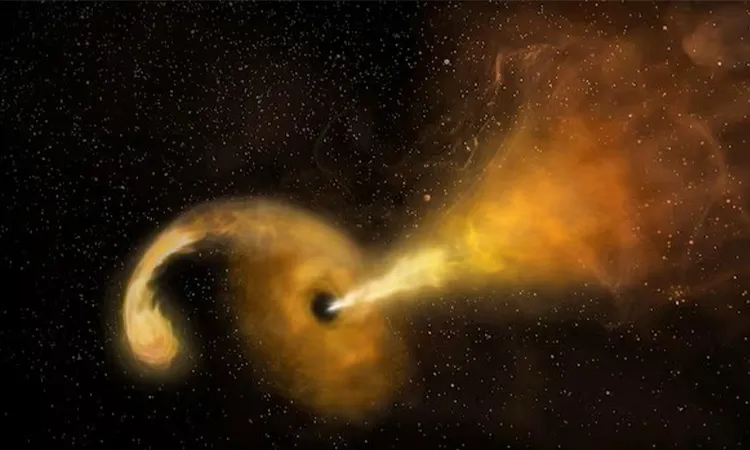
Scientists are tracking a supermassive black hole with unusually "messy" eating habits. Located in a galaxy 665 million light-years away, the black hole—nicknamed “Jetty McJetface” by researchers—is currently belching out a high-speed jet of material long after shredding a nearby star.
While black holes typically release energy immediately after a "meal," this specific event, known as AT2018hyz, has baffled astronomers. The material did not start shooting into space until two years after the star was destroyed. Now, six years later, the jet is still intensifying, becoming one of the most powerful cosmic events ever recorded.
"The rise in brightness is unprecedented," said Yvette Cendes, an astrophysicist at the University of Oregon and lead author of the study published Thursday in The Astrophysical Journal. "It is now 50 times brighter than when we first found it, and there is no sign of it stopping. That is incredibly unusual."
The Science of 'Spaghettification' The event began when a red dwarf star—about a tenth the size of our sun—wandered too close to the black hole. The black hole's immense gravity pulled on the star so violently that it stretched into a long, thin stream of gas, a process scientists call "spaghettification."
While half of the star was swallowed, the other half began swirling around the black hole. This "star stuff" heated up, creating the brilliant radio waves detected by telescopes in New Mexico and South Africa.
A Real-Life 'Death Star' The energy currently being released is staggering. Researchers estimate the jet is at least a trillion times more powerful than the fictional Death Star from Star Wars.
"It's like a picky baby chewing her food and then violently spitting it back out instead of swallowing," explained co-author Kate Alexander of the University of Arizona.
Astronomers expect the energy to peak in 2027 before slowly fading over the next decade. The delay in the jet's appearance remains a mystery, though scientists suspect it may be linked to the black hole's magnetic fields or the jet's alignment toward Earth.
Note: This report is based on a study published in The Astrophysical Journal (February 5, 2026) led by University of Oregon astrophysicist Yvette Cendes, utilizing data from the Very Large Array (New Mexico) and MeerKAT (South Africa).