- National
- Bangladesh
- Business
- International
- Sports
- Entertainment
- Politics
- Technology
- Life Style
- Religion
- Opinion
Saturday, 09 May 2026

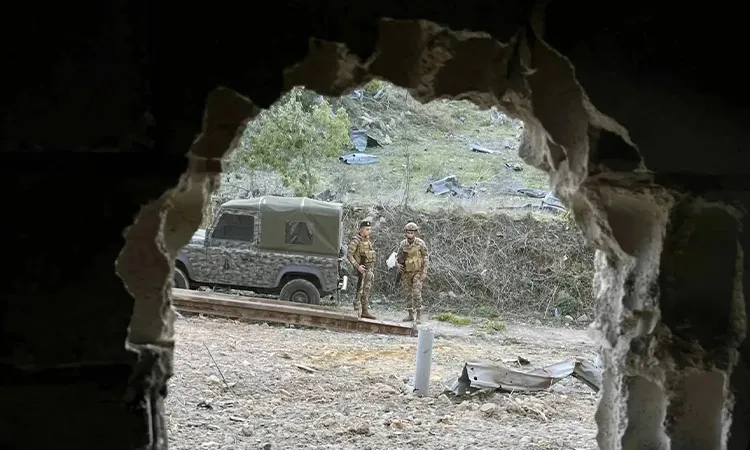
Lebanon has formally accused Israel of spraying high-concentration herbicides over southern border villages, describing the act as a "health and environmental crime" that threatens the nation's food security.
Laboratory tests conducted by the Lebanese agriculture and environment ministries confirmed the substance is glyphosate. According to Agriculture Minister Nizar Hani, samples revealed concentrations 20 to 30 times higher than standard levels, capable of destroying entire crop seasons and causing long-term soil damage.
Presidential Condemnation President Joseph Aoun denounced the spraying as a "flagrant violation of Lebanese sovereignty." He has instructed the Foreign Ministry to compile a documented legal file to submit a formal complaint to the UN Security Council.
"This is an attack on the livelihoods of our citizens and a continuation of repeated aggressions against our land," President Aoun stated.
Impact on Peacekeepers and Farmers The incident, which occurred earlier this week, forced UN peacekeepers (UNIFIL) to suspend operations for nine hours after being warned by the Israeli military to take shelter. UNIFIL noted this is not the first time such substances have been dropped over Lebanese territory.
Local farmers reported that vegetation began yellowing within 48 hours of the aerial spraying. Experts warn the impact on olive groves, tobacco crops, and natural pollinators could be devastating for a sector already suffering over $700 million in losses from recent hostilities.
Health Risks Health officials, including MP Abdul Rahman Al-Bizri, warned that aerial spraying of such high concentrations poses severe risks to civilians, especially children. Short-term exposure can cause respiratory distress and skin irritation, while chronic exposure to glyphosate is classified by the WHO as "probably carcinogenic."
While the Israeli military (IDF) claimed the operation used "non-toxic" chemicals for security purposes to clear cover near the border, Lebanese authorities reject this, citing the systematic "desertification" of inhabited agricultural zones.
Laboratory results from the Lebanese Ministry of Agriculture confirmed the presence of glyphosate at 20-30 times standard concentrations. The WHO classifies glyphosate as "probably carcinogenic," though other agencies like the US EPA disagree on its cancer risk to humans.