


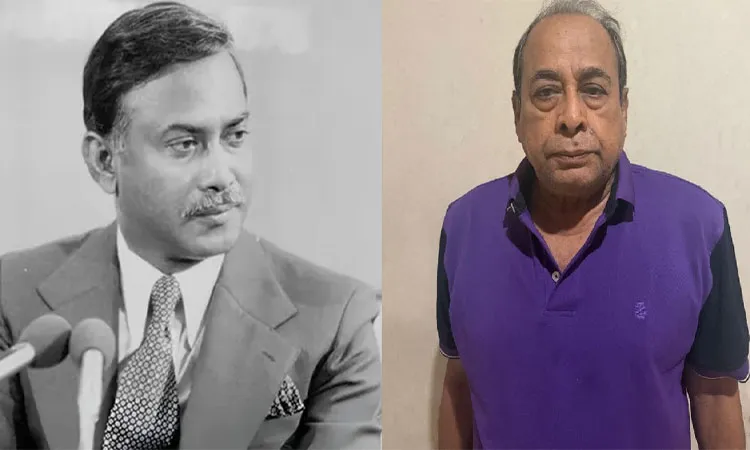
The course of history may pause but it never truly fades. No matter how clever a fugitive or how perfect their disguise the long arm of the law eventually catches up. That reality was cemented late Wednesday night when the Dhaka Metropolitan Detective Branch (DB) conducted a flawless operation in Banani DOHS, ending a 45-year manhunt.
The man arrested was Major (Retd.) Md. Muzaffar Hossain, a fugitive sentenced to death for his role in the May 30, 1981 assassination of former President and advocate of multi-party democracy Ziaur Rahman (Bir Uttam).
The operation was a masterclass in detective work on relying on just two clues: a prominent mole under the suspect’s nose and the knowledge that his daughter worked at an Airtel office. By posing as office colleagues, the DB team drew the suspect out. When the elderly man finally stated > "I am Muzaffar, the girl's father," the decades-long charade came to an end.
However, this arrest represents far more than the capture of a fugitive. It reopens the unsolved mysteries behind one of the darkest and most consequential political assassinations in Bangladesh's history.
The Legacy of Ziaur Rahman and the 1981 Tragedy
President Ziaur Rahman remains a monumental figure in the history of independent Bangladesh. From broadcasting the Declaration of Independence in March 1971 to leading a sector during the Liberation War his contributions are etched in the nation's foundation. As a statesman, he is credited with stabilizing a war-torn economy, accelerating rural development, reviving multi-party politics and strengthening Bangladesh’s international standing.
His life was tragically cut short in a cowardly attack by rebellious army officers at the Chittagong Circuit House. While 12 army officers were executed following a swift military tribunal, the true masterminds behind the assassination, the extent of international conspiracies and the broader military-political realities of that era were never fully unraveled.
A 45-Year Manhunt and Alleged Foreign Shelter
Major Muzaffar’s evasion of justice is shrouded in mystery. Commissioned from the National Guard (GRB) and serving in the 24th Infantry Division in 1981 he fled to India immediately after the assassination.
Allegations have long persisted that for 15 years, until 1996, he lived under the protection and surveillance of the Indian intelligence agency RAW using aliases such as ‘Biplab Sarkar’ and ‘Joy Banerjee.’ After returning to Bangladesh he lived undetected under a new identity. Today, Muzaffar is the sole surviving officer directly implicated in the bloody events of May 1981. His arrest provides the state with an unprecedented opportunity to extract formal statements and unlock the closed doors of history.
The Need for a High-Level Investigation
The state cannot afford to evade this historical responsibility. It is imperative that a high-level impartial investigation committee be formed immediately.
Author:
Engineer AKM Rezaul Karim Chairman - Bangladesh Nationalist Research Center, Chairman - Center for Human Rights and Human Development, Chairman - Democracy Research Center (DRC), Executive Director - Zia International Academy (Zia)

