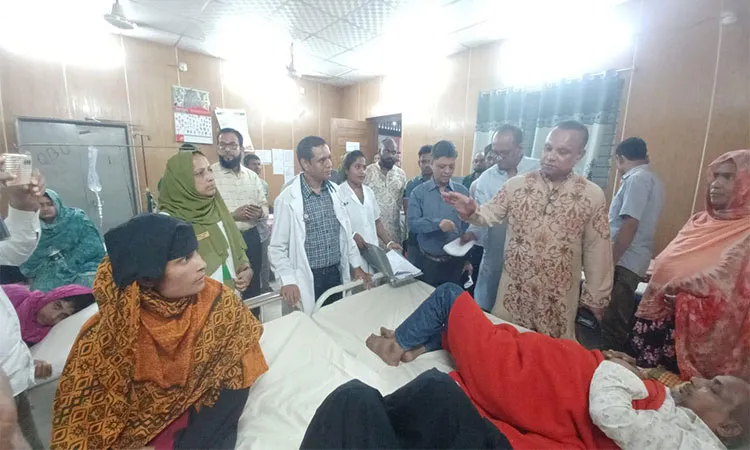
Nasrin Begum 52 had been feeling unwell for months. She was constantly thirsty, losing weight without trying, and becoming too tired to do simple household chores. At a government health center in Dhaka, a doctor suspected diabetes. But there was a problem. The clinic could not confirm it. To get a blood glucose test, she would have to go elsewhere and pay from her own pocket.
Her story is not unusual. Across Bangladesh, millions of people living with diabetes, heart disease, cancer, and chronic respiratory illnesses face the same reality. Medicines may exist, but the tests needed to diagnose disease are often unavailable. Devices needed to monitor treatment are missing. Patients are left to navigate a system that can prescribe, but too often cannot detect or track the illnesses it is trying to treat.
A recent report by the NCD Alliance, released ahead of the Fourth UN High-Level Meeting on noncommunicable diseases, warns that this is not just Bangladesh's problem. Around the world, health systems have focused on medicines while neglecting diagnostics and medical devices.
As the report puts it: "People with NCDs need a full package of services. Medicines alone are not enough. Without diagnosis and monitoring, treatment cannot work."
A system that misses disease until it is too late In Bangladesh’s primary health facilities, the most basic diagnostic tools are still missing, leaving frontline care unable to detect some of the country’s most common and deadly conditions. A national study published in PLOS ONE in 2022, covering 266 facilities across all seven divisions using WHO’s Service Availability and Readiness Assessment (SARA), found that primary care centers are not equipped to provide even minimum diagnostic services for chronic diseases like diabetes.
This gap is especially damaging for diabetes, where early detection can prevent long-term complications. Evidence from the Bangladesh Demographic and Health Survey (BDHS) 2022 shows that among adults with diabetes, only about 33.5 percent have been formally diagnosed, meaning nearly two in three, approximately 66.5 percent, remain undiagnosed. In many public facilities, blood glucose testing is simply not available. Yet this is the only practical way to diagnose and monitor the condition. In private clinics, a single test often costs 100-200 taka, which can exceed a daily wage for many workers, placing routine diagnosis out of reach for large sections of the population.
Hypertension shows a similar pattern of silent burden and weak detection. A 2025 multi-facility study covering 382 health facilities found that 75 percent were not ready to manage hypertension, with an average readiness score of just 3.72 out of 8. Even where services formally exist, basic equipment such as functional blood pressure monitors is often missing or poorly maintained. Medication availability is also limited, with preparedness as low as 29.8 percent in urban dispensaries and 9.4 percent in NGO clinics. Compounding this, only a minority of facilities have trained staff for chronic disease management, leaving many cases undiagnosed until patients arrive with complications such as stroke or heart failure.
Cancer diagnosis reveals an even deeper structural divide. Pathology and imaging services remain concentrated in major cities, while rural facilities lack the capacity for early detection. Bangladesh has only about 0.24 pathologists per 100,000 population, most based in Dhaka. As a result, cancers are frequently identified at advanced stages. A study on rural health workers found that only about one in five health assistants and just one in four community health care providers were aware of available cancer treatment options in the country, reflecting how limited diagnostic awareness is at the primary level. By the time patients reach appropriate facilities, curative treatment options are often already restricted or unaffordable.
Even where medicines are available, the absence of medical devices makes treatment incomplete or unsafe. In asthma and chronic lung disease, inhalers are the standard treatment worldwide. Yet many patients in Bangladesh still rely on oral drugs that carry higher risks and lower effectiveness.
“Patients come to us without inhalers because they cannot afford them,” said a Dhaka-based pulmonologist. “We end up prescribing alternatives that are not ideal. It compromises care.”
Lives shaped by missing tools The consequences are visible in everyday lives. Karim Khan, a garment worker in Gazipur, spends nearly one-eighth of his monthly income on blood pressure medicine. But he has never been able to measure whether it is working. After months of uncertainty, he suffered a stroke. In Sylhet, Amina Akter injects insulin daily but has no way to monitor her blood sugar. One night, she lost consciousness due to severe hypoglycemia. She survived, but narrowly. These are not rare failures. They are predictable outcomes in a system where diagnosis, treatment, and monitoring do not function together.
Such chronic diseases now account for around 70 percent of deaths in Bangladesh, rising sharply over the past two decades. Yet health spending remains low, and primary care infrastructure has not kept pace with the shift in disease patterns. Globally, the gaps are stark. Large shares of hypertension and diabetes cases remain undiagnosed. Cancer diagnostics are absent from most national plans. Essential inhalers remain inconsistently available in low- and middle-income countries.
Health experts say Bangladesh’s response must move beyond medicines alone. At the primary care level, basic diagnostic tools such as blood pressure monitors, glucometers, and ECG machines need to be widely available. Training must be paired with equipment so frontline workers can actually diagnose disease. Medical devices such as inhalers and monitoring kits must be integrated into essential health service lists and covered under public programs, rather than left to private markets. Medicine access also requires reform, including stronger price regulation, support for local production of generics, and better procurement systems to reduce shortages and cost barriers.
Some countries in the region offer working examples. Integrated primary care systems in parts of India, Sri Lanka, and Thailand have improved detection and management by combining diagnosis, treatment, and follow-up in one system. At its core, the problem is not lack of medical knowledge. It is lack of system integration. A patient who suspects diabetes must still travel to multiple providers. A diagnosed patient may receive medicine but no monitoring. A deteriorating patient often reaches hospital too late.
The cost of delay For patients like Nasrin Begum, the consequences are already permanent. Her stroke left her partially paralyzed and unable to work. Her family’s savings are gone. Her case is one of many unfolding quietly across the country. Every day, people develop conditions that go undetected. Every day, treatable illnesses become disabilities. Every day, preventable deaths occur not because treatment does not exist, but because the system cannot deliver it in full. The question now is not whether the tools exist, but whether they will be made available together. Bangladesh has already committed to improving access to essential medicines, diagnostics, and technologies. The challenge is turning that commitment into functioning care at the community level. Without that shift, the country’s health system will continue to treat diseases it cannot fully see, measure, or manage.