



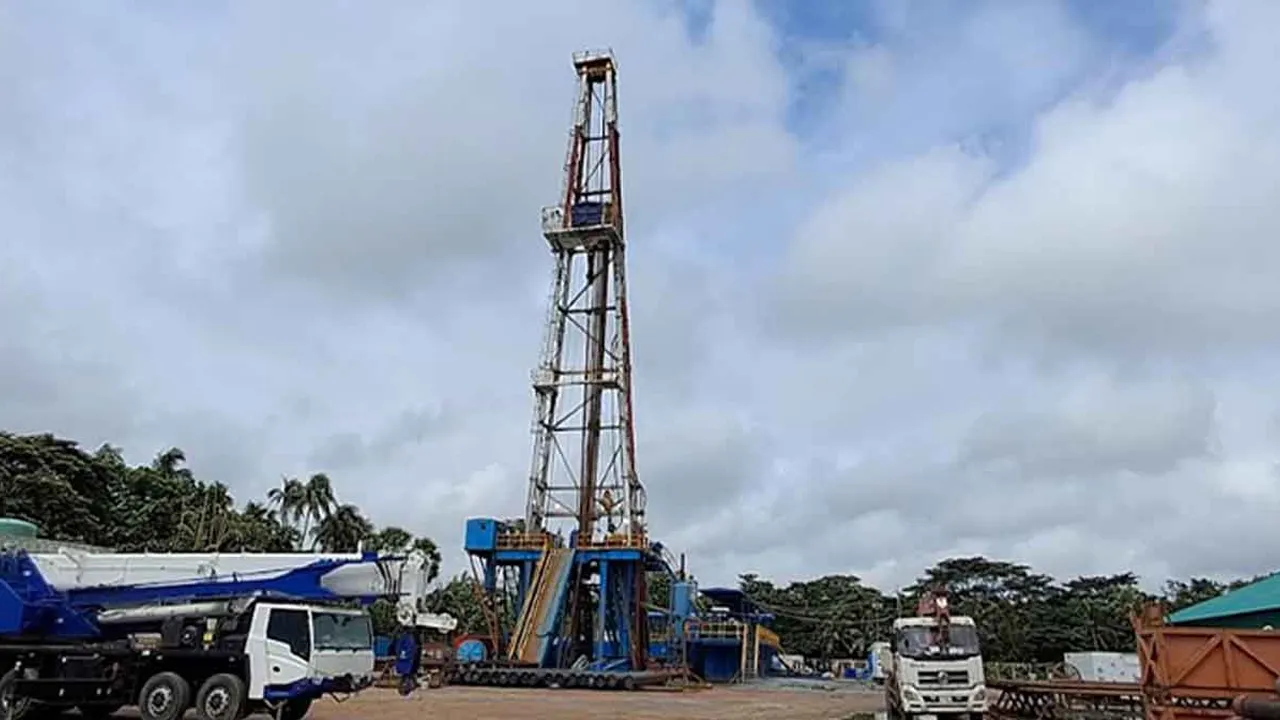
Bangladesh has accelerated efforts to increase domestic gas production and reduce dependence on imports, completing the drilling of 32 wells in the seven months since the BNP government took office. The wells are currently supplying around 147.9 million cubic feet (MMcf) of gas per day to the national grid.
The government has set a target of drilling 150 wells by 2031 to increase domestic gas production. It also plans to drill another 150 wells during 2031-35. Officials believe implementing these plans could significantly increase domestic output while easing pressure from import dependence.
According to Petrobangla data, 32 wells have already been completed under the target. Of these, 14 belong to Sylhet Gas Fields Limited (SGFL): Beanibazar-1, Beanibazar-2, Kailashtila-1, Kailashtila-2, Kailashtila-7, Kailashtila-8, Rashidpur-3, Rashidpur-5, Rashidpur-11, Sylhet-7, Sylhet-10, Sylhet-11, Sylhet-10X and Rashidpur-2.
Bangladesh Petroleum Exploration and Production Company Limited (BAPEX) completed 11 wells: Tobgi-1, Srikail North-1, Shariatpur-1, Bhola North-2, Ilisha-1, Sundalpur-3, Begumganj-4 West, Jamalpur-1, Srikail-5, Semutang-6 and Rupganj-1.
Bangladesh Gas Fields Company Limited (BGFCL) completed seven wells: Titas-14, Titas-16, Titas-24, Titas-28, Habiganj-5, Bakhrabad-7 and Kamta-2.
Petrobangla said the completed wells were initially expected to produce 134.4 MMcf of gas per day. However, Habiganj-5 produced more gas than anticipated, bringing the current combined supply from the 32 wells to around 147.9 MMcf per day.
Pipeline Constraints Limit Full Production
Petrobangla’s Reservoir and Data Management Department said the increase in production capacity cannot yet be fully utilised. Another roughly 60 MMcf of gas could potentially be added to the national grid from the completed wells, but pipeline-related constraints are preventing the additional gas from being taken into the system.
As a result, officials say expanding transmission infrastructure has become as important as increasing production capacity.
Seven more wells are currently under construction as part of the 150-well programme. They are Rashidpur-13, Sundalpur-1 and -4, Titas-29 and -31, Bhola North and Bakhrabad-6. According to Petrobangla, drilling of these wells is expected to be completed by January.
Once completed, the wells could potentially add around 96 MMcf of gas per day to the national grid. However, the full volume can only be supplied if pipeline and processing-plant capacity is sufficient.
Petrobangla said 19 projects are currently underway, while nine more are in the approval process. These projects include plans to drill 31 wells. In addition, four more wells will be undertaken through Petrobangla’s board.
Institute for Energy Economics and Financial Analysis (IEEFA) Lead Energy Analyst Shafiqul Alam said the government’s plan to increase domestic gas production is an effort to reduce the country’s future dependence on imported LNG.
“On the one hand, domestic gas production needs to be increased quickly. On the other, it must be ensured that new gas can be supplied to the national gas grid on time,” he said.
He said authorities need to make timely decisions so that newly identified gas reserves do not remain unused because of inadequate infrastructure for connecting them to the grid.
The issue is particularly urgent because the current gap between gas demand and supply already exceeds 1,000 MMcf per day, he said.
Offshore Exploration Also in Focus
The government is also focusing on gas exploration offshore, alongside onshore activities. Bangladesh has launched the Bangladesh Offshore Bidding Round 2026, offering 26 offshore blocks in the Bay of Bengal to international companies for oil and gas exploration.
Survey activities are also underway to identify specific locations for new wells. Authorities are analysing data before approving projects in an effort to drill at sites with stronger prospects.
Despite the increase in production, a gap between gas demand and supply remains. Daily gas demand currently stands at around 3,800 MMcf, while supply is about 2,600 MMcf. Of the total supply, around 1,600 MMcf comes from domestic sources and 900-1,000 MMcf from LNG.
State-owned gas-producing companies currently supply around 700 MMcf of gas per day to the national grid. Their supply has increased from around 566 MMcf per day following the addition of gas from newly completed wells. International oil and gas companies, meanwhile, supply around 900 MMcf per day.
Petrobangla Chairman Md Abdul Mannan said the government is prioritising new well drilling and workover activities at existing wells to increase domestic gas exploration and production.
“Work on 32 wells has already been completed, and gas from these wells is being added to the national grid. However, the full production capacity cannot be utilised because of pipeline-related constraints,” he said.
He said drilling of another seven wells is underway and that completing them could add a significant volume of gas to the national grid.
Mannan also said 19 projects are currently ongoing, while nine others are awaiting approval, with plans under those projects to drill 31 wells. He added that domestic exploration activities would be strengthened further to increase gas supply from local sources.
Authorities believe that increasing domestic production alongside the development of necessary infrastructure could create significant opportunities for growth in internal gas output if the plans to drill 150 wells by 2031 and another 150 during 2031-35 are implemented.
Source: BSS

