- National
- Bangladesh
- Business
- International
- Sports
- Entertainment
- Politics
- Technology
- Life Style
- Religion
- Opinion
Friday, 08 May 2026

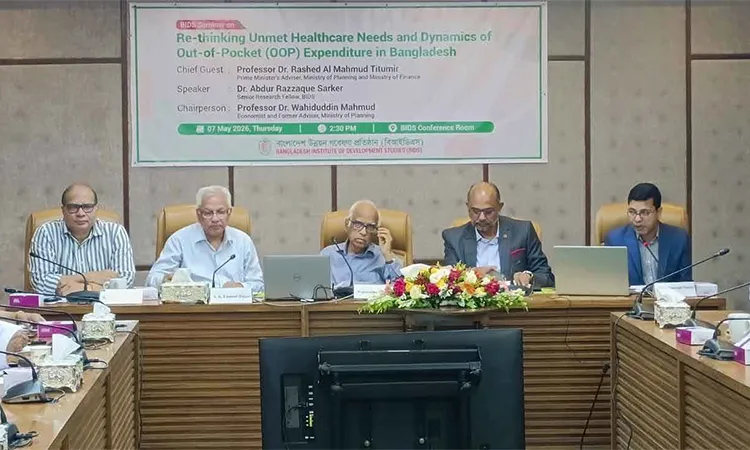
A new study by the Bangladesh Institute of Development Research (BIDS) reveals a staggering gap in the country’s healthcare system, showing that 65% of essential medical needs remain unmet primarily due to high costs.
The report, titled "Revisiting the Dynamics of Unmet Healthcare Needs and Personal Medical Expenditure," highlights how medical expenses are pushing low-income families deeper into poverty.
The study, which analyzed data from over 14,000 households, found that 79% of total healthcare spending in Bangladesh is paid "out-of-pocket" by individuals. On average, a family spends 3,454 BDT per month on medical care, accounting for roughly 11% of their total budget. However, the burden is unequal: poor families spend up to 35% of their total income on health, compared to just 5% for the wealthy.
When patients are hospitalized, the largest portion of their spending goes toward medicine and diagnostic tests rather than professional care as Medicines: 26%, Surgeries: 23%, Diagnostic Tests: 17%, Hospital Bed Rent: 16%, Doctor’s Consultation Fees: Only 5%.
The crisis is most severe in rural areas, where 68% of healthcare needs go unmet, compared to 59% in cities. At the district level, Narail and Habiganj recorded the highest rates of unmet needs, at 81% and 80% respectively. Conversely, Feni showed the best access, though only 18% of its population could fully meet their medical requirements.
BIDS researchers describe the current system as "reactive," meaning people only seek care when illness becomes critical. The study calls for urgent reforms, including strengthening primary and secondary health centers at the grassroots level.
By improving local government facilities, the state can reduce the financial disaster families face when forced to seek expensive private treatment for manageable conditions.