- National
- Bangladesh
- Business
- International
- Sports
- Entertainment
- Politics
- Technology
- Life Style
- Religion
- Opinion
- FIFA World Cup 2026
Thursday, 27 August 2026


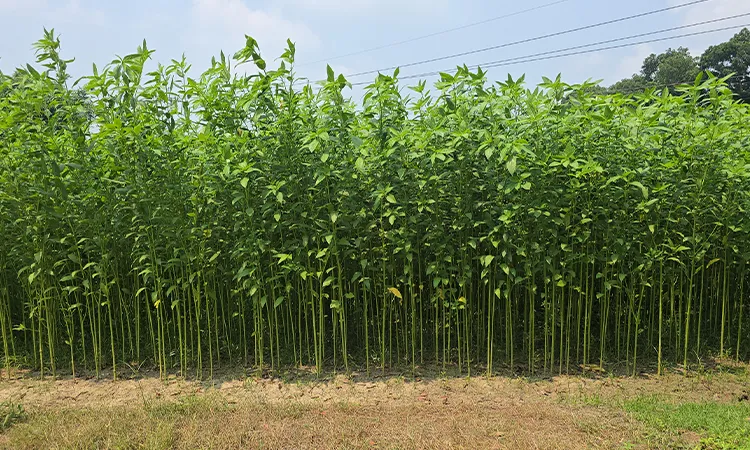
Jute cultivation across Faridpur has generated optimism for a rural economic boost this season. Known as the country's primary hub for the "golden fiber," the district has seen jute cultivation expand to 87,000 hectares of land. Favorable weather and timely rainfall have resulted in healthy crops, prompting farmers to work double-time in anticipation of a high yield.
According to the Department of Agricultural Extension (DAE), nearly 90 percent of local farmers are involved in jute cultivation during this season. Favorable weather has kept crop diseases low and accelerated plant growth.
However, farmers faced steep hurdles at the start of the season. High seed and fertilizer prices, coupled with the ongoing fuel crisis and rising labor wages, have significantly pushed up production expenses.
"Seed, fertilizer, and labor costs have spiked. It now takes 22,000 to 25,000 taka to cultivate just one bigha of jute," said M. M. Santu, a farmer from Sadar Upazila. "We will only see a profit if we get a fair price at the market."
Other local farmers noted that while the crop condition looks promising, their ultimate success depends on two factors: securing a fair market price and having enough water access for "jag" (the traditional water-retting process used to separate jute fibers).
Right now, fields across the district’s upazilas are covered in green, with farmers busy weeding, irrigating, and preparing for the upcoming harvest.
"Jute was cultivated on 87,000 hectares in Faridpur this year," said Shahaduzzaman, Deputy Director of the DAE in Faridpur. "Favorable weather points to a strong yield. Our field officers are providing round-the-clock technical support and advice to ensure farmers maintain fiber quality."
Advocate Manik Majumder, a leader of the Faridpur Krishak Samity, cautioned that a high yield does not automatically guarantee financial success. He emphasized that because input costs are so high, a strict enforcement of fair market pricing is necessary to prevent farmers from facing losses.
Despite these financial pressures, Faridpur’s farmers remain hopeful that a successful harvest and fair market returns will revitalize the rural economy.