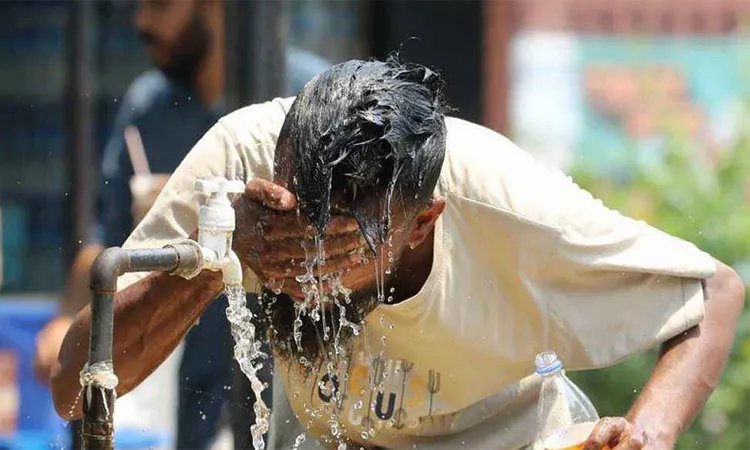
Dhaka's current temperatures may not have broken historical records, but city life has become unbearable. While the thermometer reads 36°C, it feels like 42°C. Stepping outdoors feels like entering a furnace people are sweating profusely without relief. With little shade and almost no breeze, the capital is sweltering.
Historically, Dhaka’s highest recorded temperature was 42.3°C on April 30, 1960. Decades later, temperatures peaked at 40.2°C in April 2014 and April 2023. While the actual temperature has not reached those extremes this year, the perceived heat is significantly worse.
The ‘Heat Index’ Factor Meteorologists emphasize that a thermometer alone no longer tells the whole story. The "heat index"—the combined effect of air temperature and humidity—is a more accurate measure of what the body experiences. High humidity prevents sweat from evaporating easily, trapping body heat and drastically increasing discomfort.
According to the Bangladesh Meteorological Department (BMD), Dhaka’s actual temperature at 2:00 PM on Wednesday was 36.2°C, dropping to 34.7°C by 7:00 PM. However, the "real feel" exceeded 42°C throughout the day.
No Respite at Night According to meteorologists, an abnormal rise in minimum night temperatures is a primary driver of this prolonged distress. On Wednesday, Dhaka's minimum night temperature was 28.9°C—about 6 degrees above normal.
BMD Meteorologist Muhammad Abul Kalam Mallick noted that while daytime highs of 36°C are typical for this season, the lack of nighttime cooling compounds the daytime heat. Assistant Meteorologist Afroza Sultana added that while brief seasonal Kalbaisakhi rains offer temporary relief, clearing skies quickly cause temperatures to spike again. Furthermore, southerly winds are driving up humidity, leaving people sweating continuously.
Unlike the prolonged heatwaves of 2023 and 2024, absolute temperatures are slightly lower this year. However, BMD Meteorologist Md. Shahinul Islam warned that increased water vapor after rainfall is mimicking intense heatwave conditions—a discomfort that could persist through June and July due to below-average rainfall forecasts.
Trapped in an Urban Heat Island Urban planning is exacerbating the crisis. The systematic loss of trees, open spaces, and wetlands has turned the concrete city into an "urban heat island."
A 2021 joint study by the BMD, Bangladesh Red Crescent Society, and German Red Cross identified 25 extremely hot zones in Dhaka, including Badda and Gulshan, Mirpur and Gabtoli, Farmgate and Tejgaon, Basabo and Jatrabari
Daytime temperatures in these heavily concreted areas can be up to 7°C higher than in greener outskirts. For example, when the temperature is 30°C in Savar, it can reach 37°C in Farmgate.
Professor Dr. Md. Shahidul Islam, Chairman of Dhaka University's Geography and Environment Department, pointed out a bitter irony the massive heat emitted by thousands of air conditioners in the city further warms the outside air, directly punishing those without AC. Without natural cooling from trees and water bodies, Dhaka is trapped in its own heat.