
- National
- Bangladesh
- Business
- International
- Sports
- Entertainment
- Politics
- Technology
- Life Style
- Religion
- Opinion
Wednesday, 20 May 2026

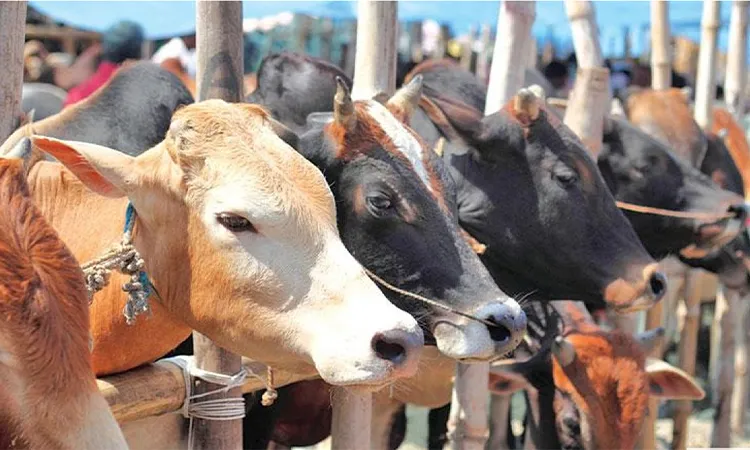
As demand for sacrificial animals rises ahead of Eid-ul-Adha in Chittagong, local production and supply are also increasing. Officials say there is no risk of a major shortage despite a gap between demand and available animals.
According to the Department of Livestock Services, the number of sacrificial animals in Chittagong has steadily increased over the past decade. Farm-based livestock rearing has also expanded significantly during this period.
This year, demand for sacrificial animals in Chittagong district is estimated at 818,671, while available animals total 783,151. This leaves a shortfall of around 35,520 animals. However, livestock officials believe the market will remain stable as animals are expected to arrive from nearby districts and northern regions.
Official data show that 386,767 animals were sacrificed in Chittagong in 2011. The number rose to about 456,000 in 2012, 460,000 in 2013 and 487,000 in 2014. In 2015, the figure crossed 500,000 for the first time. The upward trend continued, and demand reached 896,269 in 2025 across the district and metropolitan areas.
Chittagong District Livestock Officer Dr. Md. Alamgir said local farmers are now investing more in livestock farming and using improved fattening methods, which has significantly boosted production.
He said the remaining deficit would be met through supply from nearby districts. During the Eid season, traders also bring large numbers of animals from districts including Natore, Kushtia, Sirajganj, Naogaon and Mymensingh.
According to livestock department data, Fatikchhari has prepared the highest number of cattle for sacrifice this year. The upazila has 43,974 cattle ready, including 30,163 bulls, 9,969 oxen and 3,842 cows.
Banshkhali ranks second with 30,785 bulls, 5,280 oxen and 2,267 cows. Significant numbers of cattle are also available in Mirsarai, Patiya, Hathazari, Satkania, Rangunia, Sandwip, Raozan, Sitakunda, Anwara, Chandanaish, Lohagara and Boalkhali.
The district has 47,834 buffaloes prepared for sacrifice, with the highest number in Sandwip at 8,403. Goat numbers stand at 194,519, including 10,956 in Fatikchhari, the highest among the upazilas. The number of sheep is 41,423.
Officials say livestock farms have increased rapidly in recent years in areas including Fatikchhari, Banshkhali, Mirsarai, Patiya and Hathazari. Small and medium-scale farmers are now raising animals throughout the year with a focus on the Eid market. This is strengthening the local economy and gradually reducing dependence on animals from other districts.
