


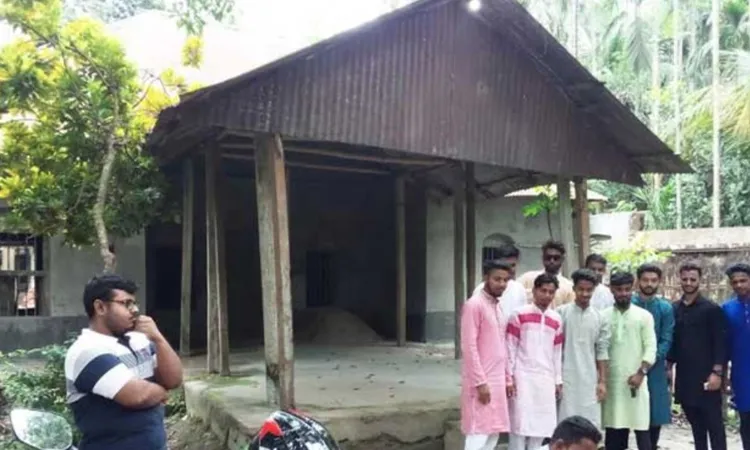
The name Tulsi Lahiri remains etched in history as a legendary playwright, actor, and filmmaker of the Indian subcontinent. Yet, despite his immense contributions to the arts, his birthplace—the Naldanga Zamindar house in Gaibandha—is on the verge of disappearing into oblivion.
Located 25 km from Gaibandha district town and 12 km from Sadullapur upazila, the Naldanga Union was the cradle of Lahiri’s creativity. Born in 1897 into a landed family, Tulsi was the son of Surendranath Lahiri and Shailbala Devi. Inspired by his father’s musical background, Tulsi eventually became a central figure in the subcontinent's cultural scene.
The once-grand estate, which witnessed the childhood of the man who revolutionized Bengali theater, is now swallowed by thickets and neglect. Naldanga Union Parishad Chairman, Abdul Gafur, expressed his frustration.
"The birthplace of this music and theater pioneer is being destroyed due to a lack of renovation. I urge the government to immediately preserve what remains of this historic landmark."
Tulsi Lahiri’s career was multifaceted. A graduate in Law (B.A. and B.L.), he practiced in Rangpur and later at the Alipore Court in Kolkata. However, his passion for the arts led him to the Megaphone Gramophone Company as a music director. He eventually abandoned his legal career to join the film and theater industry, transitioning from the silent film era to the talkies, acting in over 50 films.
Lahiri is best remembered for his plays 'Chherataar' (1950) and 'Dukhir Iman', written in the local dialect of Rangpur. These works are celebrated for their raw, realistic portrayal of rural poverty, the struggles of the peasantry, and the failures of the capitalist system. His other notable works include 'Mayer Daabi', 'Pathik', and 'Lakshmi Priyar Sansar'.
Today, the physical remnants of his legacy are few. Visitors can still find a black stone Shivlinga and a white stone Krishna temple, alongside a dilapidated bedroom, a Kachari (office) house, and an ancient well (Indira). A massive 18-acre pond, known locally as a Sarovar, still exists, but the buildings themselves are crumbling.
Local youth and tourists who travel to see the heritage site often leave disappointed. Mostafiz, a visitor from Gaibandha, shared his frustration: "It is painful to see the home of such a scholar in this condition. The state must step in."
Tulsi Lahiri’s grandson, Tanmay Lahiri, and great-grandson, Taushik Lahiri, are the remaining descendants living at the site. Taushik lamented the lack of official recognition "Many journalists have visited and reports have been published, but neither the state nor civil society has taken action. We are barely holding onto these memories ourselves. If this continues, the name of Tulsi Lahiri will be erased from history."
Tulsi Lahiri passed away in Kolkata on June 22, 1959, at the age of 62. While his plays continue to be studied by theater enthusiasts, the home where his journey began is quietly turning to dust.
