- National
- Bangladesh
- Business
- International
- Sports
- Entertainment
- Politics
- Technology
- Life Style
- Religion
- Opinion
Friday, 20 March 2026

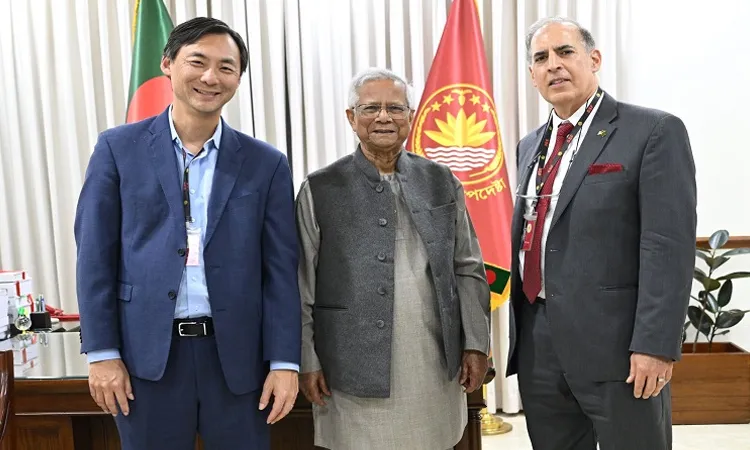
Chief adviser Professor Muhammad Yunus said that the interim government is committed to holding the general elections and referendum on February 12 as scheduled.
He made this statement when Albert Gombis and Morse Tan, two former senior US diplomats who served in the Donald Trump administration, paid a courtesy call on the chief advisor at the state guest house, Jamuna, on Tuesday evening.
At the time, the chief advisor said that there has been a flood of fake news and planned confusion surrounding the election. However, the interim government is steadfast in its promise to hold the election on February 12. The interim government will hand over power to the democratically elected government after announcing the election results.
"It doesn't matter who said what. The election will be held on February 12th as scheduled; not a day before, not a day after," said the chief advisor.
Final meeting of 11 parties on seat sharing today, decision to be made by evening He also said that the election will be free, fair, peaceful and in a festive atmosphere.
The chief advisor said that the interim government will remain completely neutral during the election period and will conduct a bias-free administration by ensuring equal opportunities for all political parties. Former US Acting Under Secretary of State Albert Gombis and former Ambassador-at-Large Morse Tan are visiting Bangladesh ahead of the election.
In the nearly hour-long meeting, the chief advisor and visiting diplomats discussed various important issues including the upcoming elections, the July uprising and its aftermath, the rise of young activists, the July Charter and referendum, fake news and misinformation spread targeting the elections, the Rohingya crisis, and the possibility of 'truth and reconciliation' in the context of post-July Bangladesh.
The chief adviser said the interim government is campaigning for a 'yes' vote in the referendum. If approved by the people, the July Charter will usher in a new era of democratic rule and leave no room for dictatorship in the future.
Professor Yunus said that supporters of the then fascist government were spreading fake news and disinformation to create confusion around the elections. However, the public is now aware. They are gradually being able to identify fake videos created with artificial intelligence (AI).
Former Undersecretary Gombis agreed, saying fake news has emerged as "one of the main enemies" of democracy around the world and that stronger efforts are needed to counter this threat.
The two diplomats praised the Chief Advisor for his important role in running the government over the past year and a half. They wanted to know whether it is possible to adopt a Truth and Reconciliation initiative in Bangladesh, similar to that of post-apartheid South Africa.
Professor Yunus said that as a friend of the late Nelson Mandela, he closely followed the Truth and Reconciliation process in South Africa. However, he does not see the possibility of taking any such initiative in Bangladesh at this time, as the then fascist regime denies its crimes.
He said, 'The time is not right yet. Where to start? Truth and reconciliation is only possible when someone admits that they have made a mistake, repents for their crimes, and expresses remorse.'
"But so far they have no remorse, no regrets. Instead, they are claiming that the young people killed in the July coup were killed by terrorists. There is a huge amount of evidence of their crimes. What they have done is a completely barbaric crime, yet they are in complete denial."
SDG Coordinator and Senior Secretary Lamia Morshed was also present at the meeting.
Comment